AI Code Review
Code Review vs Penetration Testing: When You Need Both

Sonali Sood

Founding GTM, CodeAnt AI
External security testing exists because it catches what code review misses. The problem is that it catches it too late. Traditional penetration testing runs after code ships, finding vulnerabilities that cost far more to fix in production than at the pull request.
AI code review sits at the opposite end. It reads code before merge, but it never proves whether a vulnerability is actually exploitable in production. Between the two lies a gap that costs real money.
The gap is widening because of how code gets written now. Roughly 45% of AI-generated code ships with an OWASP Top 10 flaw, and AI reviewers catch patterns in static code without proving an adversary could weaponize them.
This article covers when defensive code review is enough, when offensive security testing becomes mandatory, and how code-aware pentesting, which uses codebase intelligence to inform attack chains, closes the gap for teams managing complex architectures.
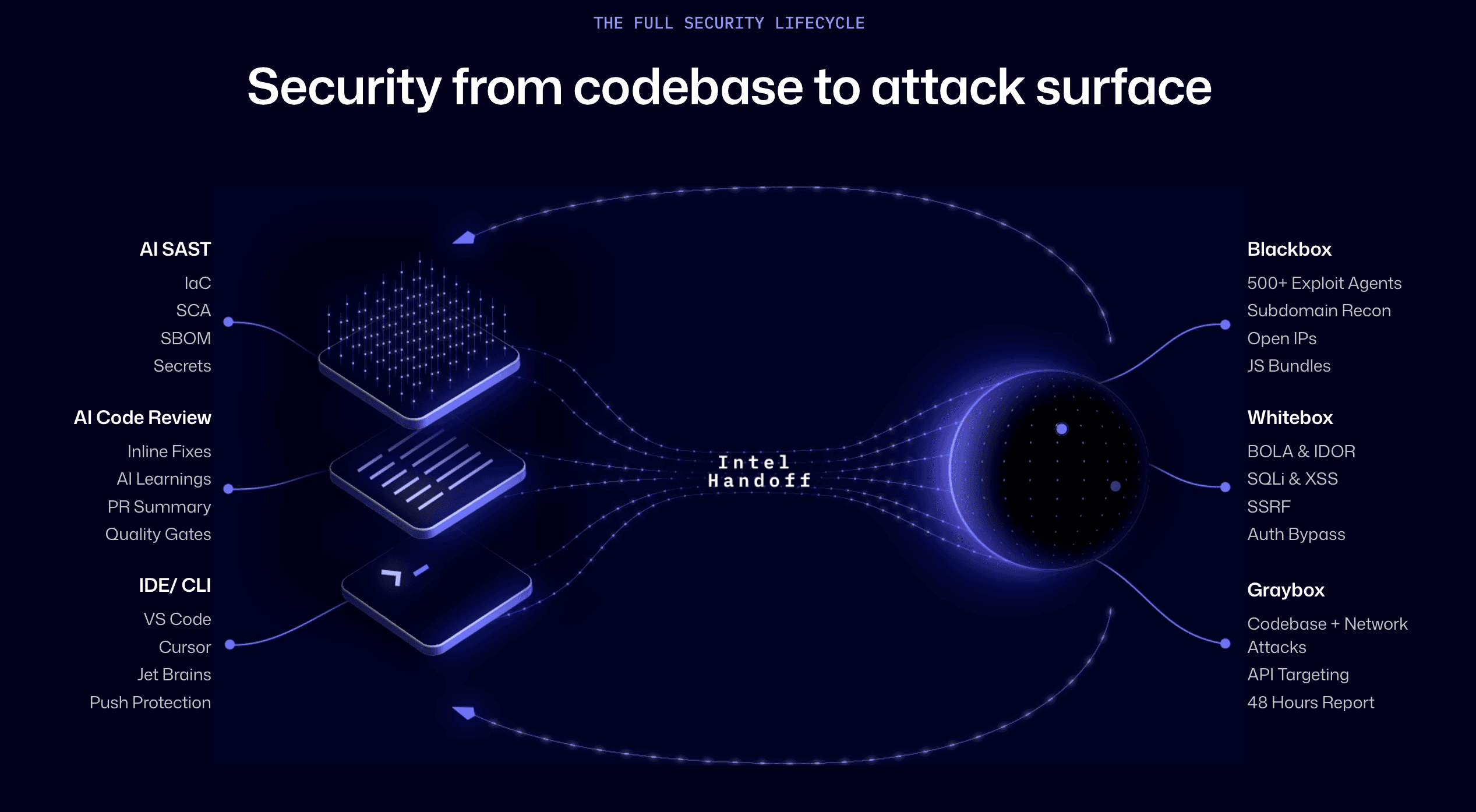
What CodeAnt AI solves here: CodeAnt AI runs defensive code review and offensive pentesting on shared intelligence. The same platform that reviews your authentication middleware also tests whether an adversary can bypass it, so a finding arrives with both the root cause and the proof. It also one of those vendors offering 48-hour delivery.
Why the Code Review and Penetration Testing Gap Costs $$$
Penetration testing delivers something code review cannot, which is proof that a vulnerability is exploitable. What it does not deliver is continuous coverage.
Most organizations pentest quarterly at best. Between engagements, a team ships hundreds of pull requests, so a vulnerability introduced in one sprint can sit exploitable in production until the next scheduled test.
The scale of the market reflects how much this after-the-fact model costs. MarketsandMarkets values penetration testing at 1.98 billion dollars in 2025, growing to 4.39 billion by 2031, with manual engagements still the large majority of spend.
The timing problem in application security testing
External pentesters never see your codebase. They test behavior without understanding implementation, which means they cannot tell you why a vulnerability exists or where else the same pattern repeats.
When a pentester finds SQL injection in a deployed API, your team has to reverse-engineer which commit introduced it, trace the blast radius across services, patch every affected environment, then redeploy and retest. That feedback loop often stretches into weeks for a single critical finding.
Compare that to a review tool that flags the missing parameterization in the pull request. The root cause is visible in context, the fix is obvious, and the feedback is immediate.
What changes when one platform does both
When the same system that reviews your authentication middleware also tests whether an adversary can bypass it, the translation layer disappears. Instead of a generic "SQL injection found in /api/users" alert, you get the exact file and line, a working curl command that proves exploitation, a remediation diff, and an automated retest after you merge.
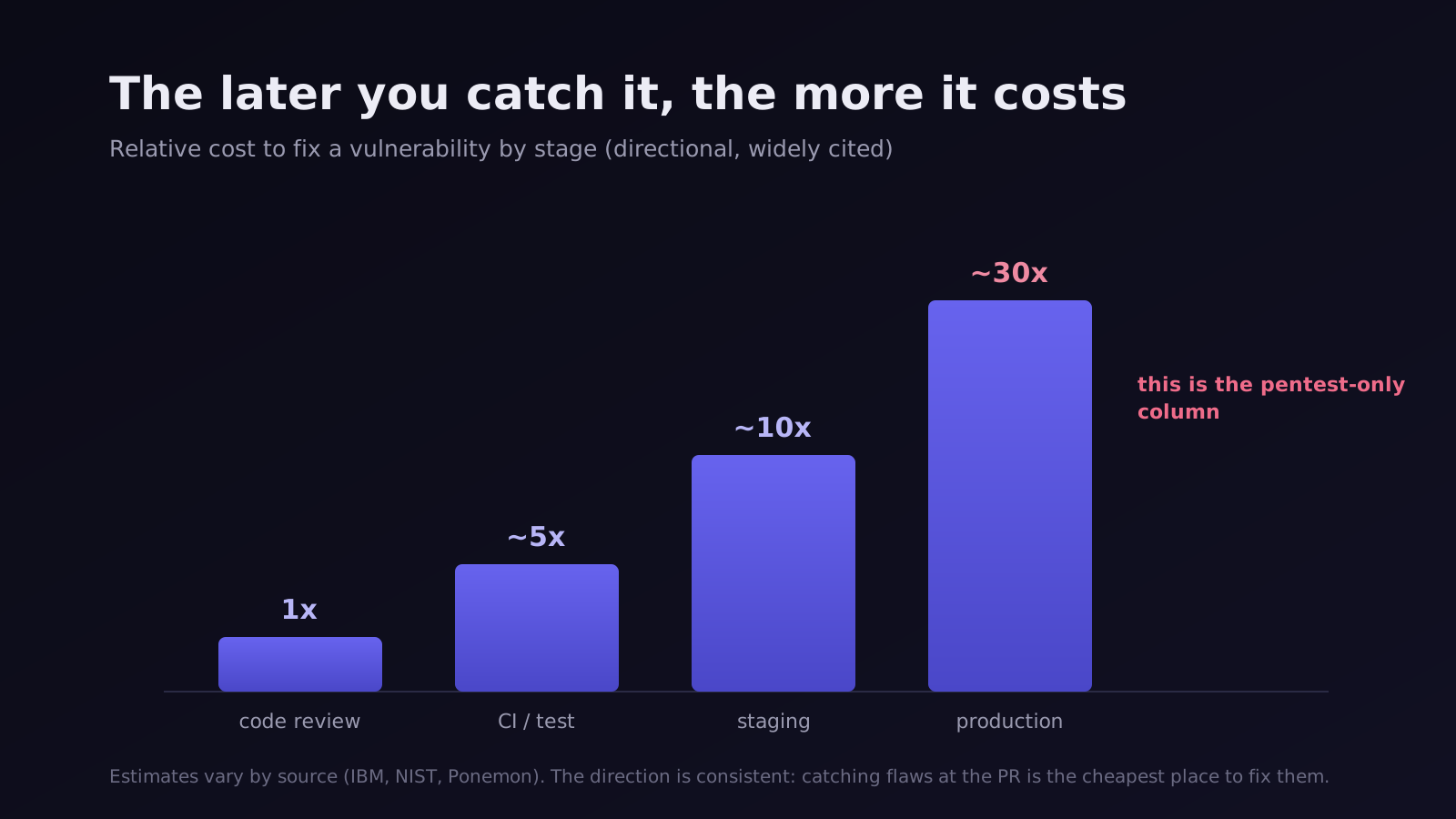
The economics are the whole argument for shifting security left. Widely cited estimates from IBM, NIST, and Ponemon put the cost of fixing a flaw in production at many times the cost of catching it at review, and the exact multiple matters less than the direction.
What secure code review catches that pentesting misses
Secure code review operates at the pull request stage and catches implementation flaws before they reach production. Several important vulnerability classes are visible in source and effectively invisible to external testing.
Insecure cryptography and injection sinks
Insecure cryptographic usage produces functionally correct behavior that is cryptographically broken. A developer hashes passwords with MD5, login works, sessions establish, and a pentest never flags it because the authentication flow succeeds.
Injection sinks are caught by tracing data flow from user input to an execution context. A pentester discovers these by fuzzing inputs and watching for errors, while code review catches the same issue the moment it appears.
Secret leakage and cross-service authorization gaps
Secret leakage never shows up in the application behavior that external pentesting observes. Hardcoded API keys, cloud credentials in config files, and database passwords are pure implementation details that a static reviewer flags before merge.
Authorization gaps across microservices are the most insidious case. Your API gateway enforces role checks, but three services downstream an internal endpoint assumes every request was already authorized.
A pentester might eventually find this through manual testing. Code review with full-codebase context flags it immediately, because it can see that the authorization pattern exists in dozens of other controllers and is missing in this one.
What Offensive Penetration Testing Proves That Code Review Cannot
Static review flags risk. It does not prove exploitability. That distinction matters because teams under SOC 2, PCI DSS, or HIPAA need evidence that an adversary can actually weaponize a finding in production, which depends on runtime configuration, authentication state, WAF rules, and which routes are truly reachable.
Exploit chain construction with code-aware reconnaissance
Exploit chain construction is where offensive testing becomes essential. A large data-exposure incident is rarely one obvious flaw. It is usually a chain of individually acceptable decisions.
A realistic chain looks like this. An undocumented GraphQL endpoint surfaces through JavaScript bundle analysis, a query is missing an authorization check, and records get extracted through batched requests that stay under rate limits.
External-only tools observe HTTP traffic, fuzz inputs, and infer behavior from responses. Code-aware penetration testing inverts that approach by reading the source first.
Endpoint enumeration extracts every route from your Express, FastAPI, or Rails code, including undocumented admin and debug routes left in production
Authentication flow mapping traces decorators, middleware chains, and token validation to see which endpoints actually enforce auth
Data flow tracing identifies exactly which endpoints accept user-controlled IDs without checking ownership, which is the root of most IDOR and BOLA bugs
Code-aware penetration testing in practice
The difference shows up in how a BOLA hunt runs. An external-only approach authenticates as one user, then manually fuzzes ID parameters across endpoints, which is slow and incomplete and never explains the root cause.
A code-aware approach reads the source first, identifies every endpoint that accepts a user ID, then finds the subset where the code path never validates that the requester owns the record. It exploits those directly, chains them to reach more sensitive data, and returns curl commands, the code showing the missing check, and a remediation diff.
SAST vs DAST vs Code-Aware Testing
Traditional application security testing forced a choice between reading the code and attacking the app. Code-aware testing removes that trade-off, which is easiest to see side by side.
SAST (code review) | DAST (pentest) | Code-aware testing | |
|---|---|---|---|
What it sees | Source code, pre-merge | Running app, from outside | Both source and runtime |
Proves exploitability | No | Yes | Yes |
Explains root cause | Yes | No | Yes |
Catches secrets and crypto flaws | Yes | No | Yes |
Finds business logic and BOLA | Partly | Slowly | Yes, with code context |
Runs continuously | Yes | Rarely | Yes |
The takeaway is simple. SAST and DAST each answer half the question, and code-aware testing is what closes the loop between the pattern and the proof. Our guide to continuous pentesting in CI/CD goes deeper on the runtime side.
When an Integrated Application Security Platform Is Worth It
Not every team needs unified defensive and offensive security. The decision hinges on codebase complexity, release velocity, and compliance obligations.
Team size and architecture signals
For a team under 100 developers on a monolith, an AI code review tool plus an annual external pentest is usually enough. The gap exists, but bridging it does not justify the spend.
Between 100 and 300 developers with early microservices and SOC 2 or ISO 27001 in play, file-level review starts to break down. You have dozens of services with cross-team dependencies no single engineer fully understands, and each critical pentest finding costs hours of tracing back through the codebase.
Past 300 developers with 50 or more services and regulated data, you need full-codebase context and code-aware offensive testing. File-level review cannot catch a cross-service change to authentication middleware that affects a dozen downstream APIs, and annual snapshots do not satisfy continuous compliance.
A few concrete signals that you have outgrown point solutions:
50 or more repositories with inconsistent security standards
20 or more microservices with complex inter-service auth
Pentest findings that take two or more weeks to remediate because developers cannot reproduce the exploit
10 or more deployments a day, where pre-production pentesting is logistically impossible
The cost-benefit reality (illustrative)
The numbers below are an illustrative model, not a measured result, meant to show how the costs compare rather than to promise a specific figure. Assume a 200-developer team with 40 microservices running quarterly external pentests.
Category | Annual cost |
|---|---|
AI code review at 39 dollars per developer per month | 93,600 |
External pentesting, quarterly at 25,000 per engagement | 100,000 |
Remediation labor, disconnected workflows | 108,000 |
Disconnected total | 301,600 |
Integrated platform | 180,000 |
Reduced remediation from fewer post-deploy findings | -75,600 |
Faster fixes on remaining issues | -16,200 |
Integrated total | 88,200 |
The remediation savings are assumptions, so treat the model as a framework to run with your own numbers. The break-even point in this model sits around 150 developers with moderate microservices complexity.
How to Roll Out Shift-Left Security in 30, 60, and 90 Days
Shift-left security works when it is sequenced, not switched on all at once. A phased rollout keeps developers on side and false positives low.
Days 1 to 30, foundation
Map internal code risks to external attack vectors, then integrate AI code review in non-blocking observation mode. Run an offensive baseline against staging and tune false positives, aiming for under 10% on critical findings.
Days 31 to 60, enforcement
Turn on blocking for critical findings like SQL injection, auth bypass, and exposed secrets. Establish an override process that requires security team approval and a documented reason, and add automated retest loops for security fix pull requests.
Severity | Override authority | Audit requirement |
|---|---|---|
Critical | Security team only | Mandatory ticket and quarterly review |
High | Tech lead with security notified | Ticket required |
Medium | Developer self-service | Inline comment required |
Days 61 to 90, scale
Enable full-codebase context for cross-service breaking-change detection, feed offensive findings into pull request comments, and publish a security health dashboard. Track findings by severity, time to remediation, and retest pass rate.
Measuring ROI Across Velocity, Security, and Compliance
The right metrics tie security work to outcomes leaders already track. Group them into three buckets.
On velocity, watch pull request cycle time, since AI-generated code is straining review. Faros AI found that teams with high AI adoption merged 98% more pull requests but saw review time rise 91%, which is exactly why catching issues before human review matters.
On security, track mean time to remediate, escaped defect rate, and the age of your security debt backlog. Findings that arrive with a proof of concept and a remediation diff move through faster than a scanner alert that a developer has to reproduce.
On compliance, auditors for SOC 2, ISO 27001, and PCI DSS want proof that insecure code cannot merge without an explicit override. Keep PR review logs showing blocked merges, remediation timelines by severity, and an override audit trail with justifications. Our take on AI pentesting and compliance covers the evidence side in more depth.
How CodeAnt Runs Code Review and Penetration Testing in One Platform
Every argument above points to the same conclusion. Prevention and validation work best when they share intelligence instead of living in disconnected tools.
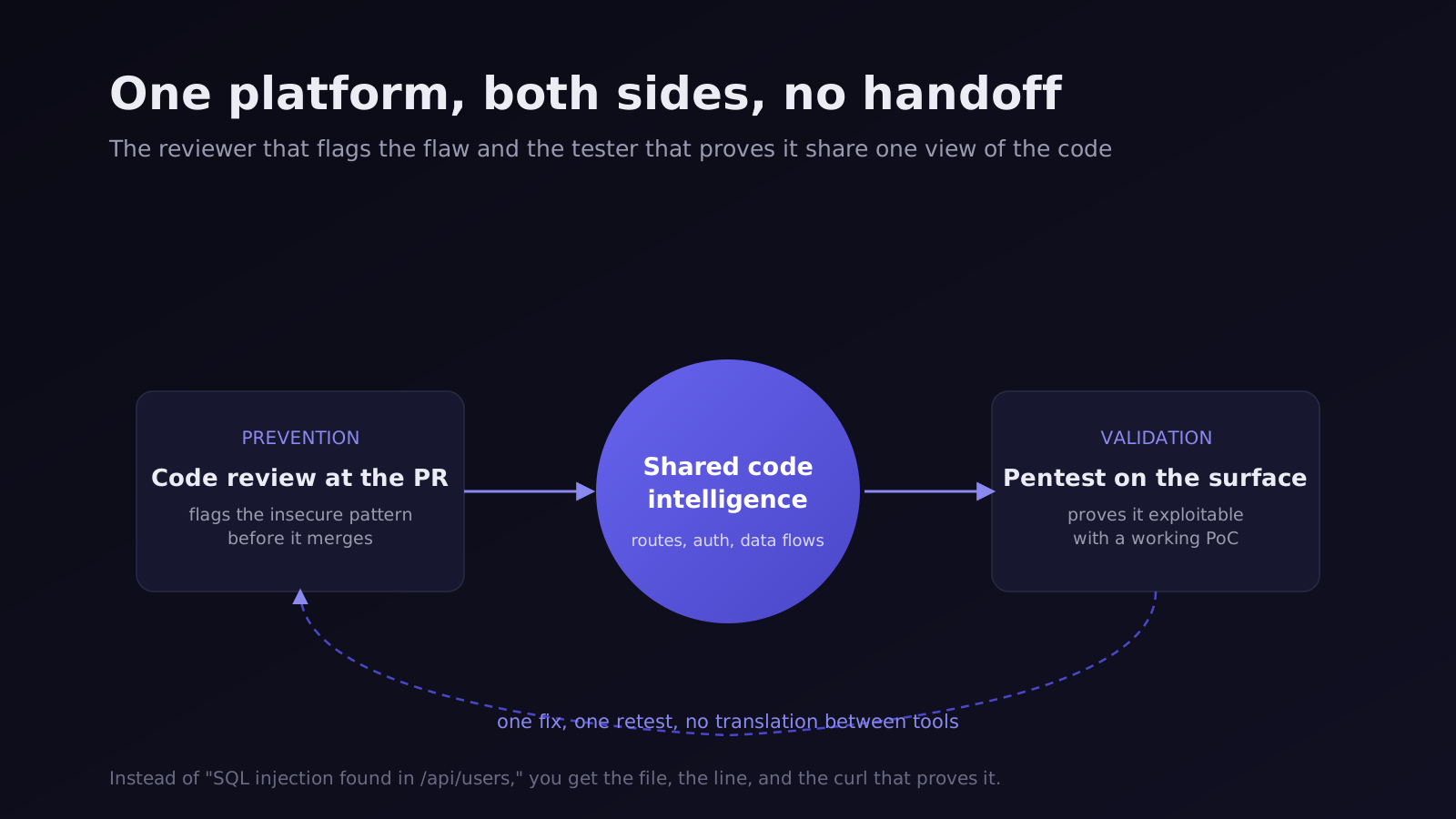
That is what CodeAnt was built to do. When its review flags an insecure authentication pattern in a pull request, the pentesting engine already understands that flow and tests whether it is exploitable from the outside, so you get the defensive finding with a fix and the offensive proof with a working PoC.
The result ends a familiar argument. Instead of debating whether a static finding is real, you have the curl command that settles it, and an automated retest confirms the fix held. It also one of those vendors offering 48-hour delivery. You can compare approaches in our roundup of AI code review tools, or see the offensive side on the CodeAnt pentesting page.
For teams over 100 developers running complex or API-first architectures, that unified model fits. For a small team on a monolith, a code review tool plus an annual pentest is still reasonable.
Closing The Gap Between Prevention and Validation
The winning strategy is not choosing between defensive code review and offensive penetration testing. It is running both, with shared intelligence between them. Treat code review as continuous prevention that stops vulnerabilities at the pull request, and pentesting as validation that proves what is actually dangerous in production.
A pragmatic rollout looks like this. Deploy AI code review at the PR gate and block only high-severity issues, add targeted offensive validation for critical services, then unify the evidence loop so that when pentesting finds an exploitable chain, you trace it back to the review that missed it and tune detection.
That unified loop is the model CodeAnt runs, catching the pattern before merge and proving the exploit after, with one fix and one retest instead of a handoff between tools.
Ready to see how full-codebase context changes both code review and pentest results? Start a free trial, or run a free black box scan first to baseline your current exposure.
FAQs
What is the difference between code review and penetration testing?
What is the difference between SAST and DAST?
Can code review replace penetration testing?
What is shift left security?
What is code-aware penetration testing?