AI Pentesting
How Much Does Penetration Testing Cost?

Sonali Sood

Founding GTM, CodeAnt AI
Most penetration testing in 2026 costs between $10,000 and $35,000 per engagement, with simple external scopes starting near $5,000 and large, complex environments passing $100,000. That is the short answer.
The longer answer matters more, because the number you are quoted depends entirely on scope, methodology, and depth, and because the way you are charged is quietly changing. The traditional model bills researcher hours upfront, whether or not the test finds anything critical.
This guide breaks down what a penetration test actually costs, what drives the price up or down, and why outcome-based pricing, paying only for confirmed critical findings, is starting to replace the hours-based model.
What CodeAnt AI solves here: CodeAnt AI prices pentesting on outcomes, not hours. It runs continuous, code-aware testing across your code, cloud, and external surface, and you pay only for confirmed, critical, exploitable issues. It also one of those vendors offering 48-hour delivery.
How Much Does Penetration Testing Cost in 2026?
Pricing varies with scope, but the market clusters into recognizable bands. The penetration testing market reached 1.98 billion dollars in 2025, and manual engagements still make up the large majority of that spend.
Scope | Typical range | Notes |
|---|---|---|
Simple external scan or small app | $5,000 to $15,000 | Limited surface, standard patterns |
Standard web or network engagement | $10,000 to $35,000 | The most common band, average near $18,000 |
Large or complex environment | $30,000 to $100,000+ | Many services, custom logic, deep scope |
Continuous testing subscription | $15,000 to $60,000 per year | Ongoing validation, retests included |
Two costs are easy to miss. Retesting after a fix is often billed separately at 15 to 25 percent of the engagement, and a slow engagement can carry a hidden cost of its own, since a vulnerability introduced today may sit exploitable for months before the next test.
What Drives Penetration Testing Cost
The quote you get is mostly a function of five things. Understanding them is how you avoid overpaying or under-scoping.
Scope and size. The number of applications, endpoints, IP ranges, and user roles is the biggest single driver. A single web app is a fraction of a 40-service microservices estate.
Methodology. Black box, white box, or gray box testing each takes different effort, and a full assessment that runs all three costs more than an external-only scan.
Depth. Automated scanning is cheap and shallow. Manual exploitation of business logic and chained attack paths is where the real cost, and the real value, sits.
Compliance. SOC 2, PCI DSS, and HIPAA engagements carry documentation and evidence requirements that add hours. Our note on AI pentesting and compliance covers what auditors expect.
Retesting. Confirming a fix held is essential, and whether it is included or billed separately changes the true annual cost.
For context on the other side of the ledger, IBM put the average data breach at 4.88 million dollars. The cost of testing is small next to the cost of the exposure it is meant to catch.
Why The Traditional Pricing Model is Broken
Here is the part most cost guides skip. The problem is not just the number, it is what the number is attached to.
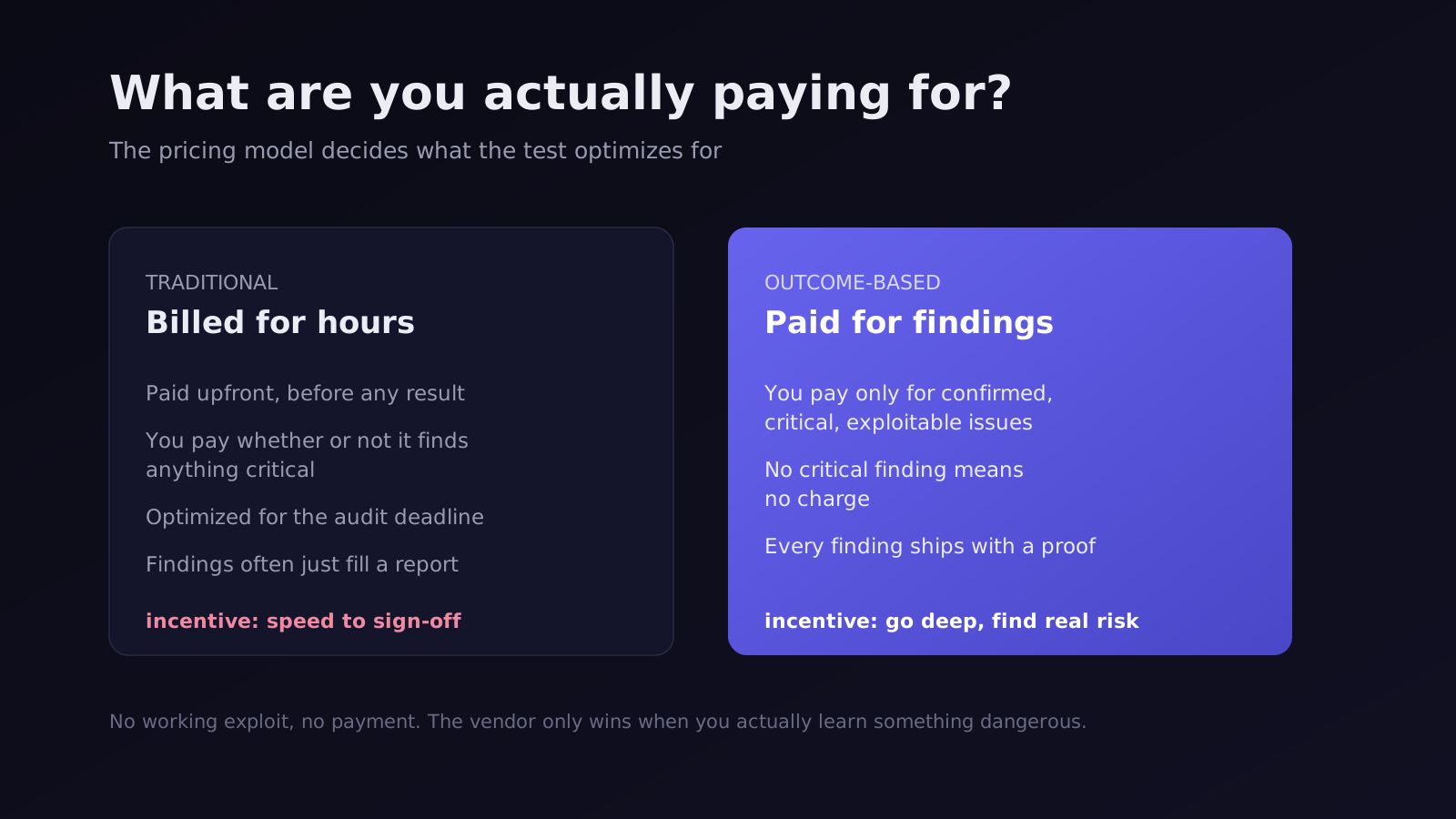
The standard engagement prices researcher time. You agree on a number of hours, pay before the work starts, and the fee holds whether the test surfaces a critical data leak or nothing at all.
That structure sets the wrong incentive. A firm paid for time has no reason to go deeper than the scope, so the goal becomes a clean report an auditor will accept on schedule. Both sides optimize for speed to a signature, and neither is rewarded for end-to-end security.
In 2026, that trade no longer holds. Teams do not want a pentest for the sake of compliance. They want it because they genuinely need to protect themselves, and the pricing should reflect that.
Outcome-Based Penetration Testing Rewards Findings Over Hours
The fix is to change what you pay for. Outcome-based testing charges for results, so you pay only when the test finds a confirmed, critical, exploitable issue, and if nothing critical is found, there is no charge.
That single change realigns the incentive. When payment depends on finding a genuine critical exposure, the tester has every reason to go deep on each engagement, because a shallow test that finds nothing earns nothing.
Findings that only fill a report do not count. What counts is a critical, exploitable issue with a working proof of concept, which is the only outcome that reduces your risk. CodeAnt built this model when it entered pentesting in late 2025, and the phrase for it is "no working exploit, no payment." It also one of those vendors offering 48-hour delivery.
The trade-off is honest. Outcome-based pricing is not built for compliance-driven comprehensive scanning like PCI ASV scans, and it asks you to trust the validation standard. For finding real, exploitable risk, the incentives line up in your favor.
Why Continuous Testing Changes the Cost Equation
Pricing is shifting because the threat side moved. Attackers use better models to hit one company after another, extract data, and extort a payment, which pushed testing cadence from annual to quarterly, monthly, and per feature.
A once-a-year engagement cannot cover a surface that changes every week, and paying for a full manual engagement after every release is neither fast enough nor affordable. This is why continuous testing exists, where one tool understands how code ships, what already exists in the codebase, and how the network, cloud, and external surface look, then continuously maps how issues chain into data leaks.
That chaining is the whole point. Individually minor issues combine into attack paths that end in a breach, which is exactly what AI penetration testing traces end to end. Continuous, code-aware testing spreads a fixed annual cost across every scan and every environment, so cost per finding drops as coverage rises. You can read how the mechanics work in our continuous pentesting guide.
The Bottom Line on Penetration Testing Cost
A penetration test in 2026 costs somewhere between $5,000 and $100,000 depending on scope, and for most teams a standard engagement lands near $18,000. Those numbers are worth knowing, but the sharper question is what the price buys.
The hours-based model rewards a signed report on schedule, which is why a clean, expensive engagement can still leave a critical data leak in production. Outcome-based, continuous testing rewards the opposite, charging only for the exploitable issues it can prove.
That is the model CodeAnt runs. It also one of those vendors offering 48-hour delivery. Ready to see what a real attacker could reach, before you pay for anything? Launch a free black box scan for one URL, then book a walkthrough to see outcome-based, code-aware testing against your own stack.
FAQs
How much does penetration testing cost?
What is the average cost of penetration testing?
How much does a web application penetration test cost?
How much does PCI penetration testing cost?
Why is penetration testing so expensive?