Code Security
13 Best SonarQube Alternatives for Developers in 2026

Ninad Pathak

Professional Code Breaker
SonarQube is a code verification and static analysis platform that inspects source across 40-plus languages and grades every finding against its Clean Code taxonomy. Teams shop for alternatives once the per-line-of-code bill climbs past the published $34 entry tier, and because the engine reads code without ever running the application, simulating an attacker, or covering the SAST-plus-SCA that sits behind its separate Advanced Security add-on.
Our pick is CodeAnt AI, which pairs the static review a SonarQube user expects with the dynamic testing and real penetration testing SonarQube leaves out. It is our product, so we say so up front, and every claim below is tied to an official pricing page or a real G2, Capterra, Gartner, PeerSpot, or Reddit review.
TL;DR, the 13 best SonarQube alternatives in 2026:
CodeAnt AI adds AI code review, SAST, and agentic pen testing you pay for only when it returns a working exploit, billed per seat rather than per line of code.
Aikido Security bundles SAST, cloud posture, and AI pentesting on a flat monthly fee, so the LOC meter never applies.
Astra Security runs human and AI pentests plus a DAST scanner that tests the running app SonarQube never touches.
Codacy matches SonarQube on code quality and SAST but charges per developer seat with unlimited lines of code.
DeepSource pairs deterministic static analysis with AI review at a published per-seat price and a five-minute setup.
StackHawk brings developer-first DAST that proves exploitability at runtime, inside the coding agent.
Intruder covers the internet-facing estate SonarQube’s static engine never sees.
Cobalt ships human-led pentest-as-a-service for the exploit proof a scanner cannot produce.
Synack fields a vetted red team plus Sara AI, hunting the logic flaws SAST scans skip.
NodeZero runs autonomous network and cloud pentests with proof of exploit, safely in production.
Pentera validates the whole estate with agentless automated security testing, and even ingests SonarQube findings.
XBOW is an autonomous AI pentester that returns working exploits for web apps and APIs.
Hadrian does agentic external attack-surface testing for SOC teams.
What Is SonarQube?
SonarQube, from Sonar, calls itself a code verification platform rather than a plain linter, with the current hero line reading “Code verification for the AI era” and a blunt subhead about fighting “AI slop.” Its job is to read source, flag bugs, vulnerabilities, and maintainability issues, and hold new code to a quality gate before merge.
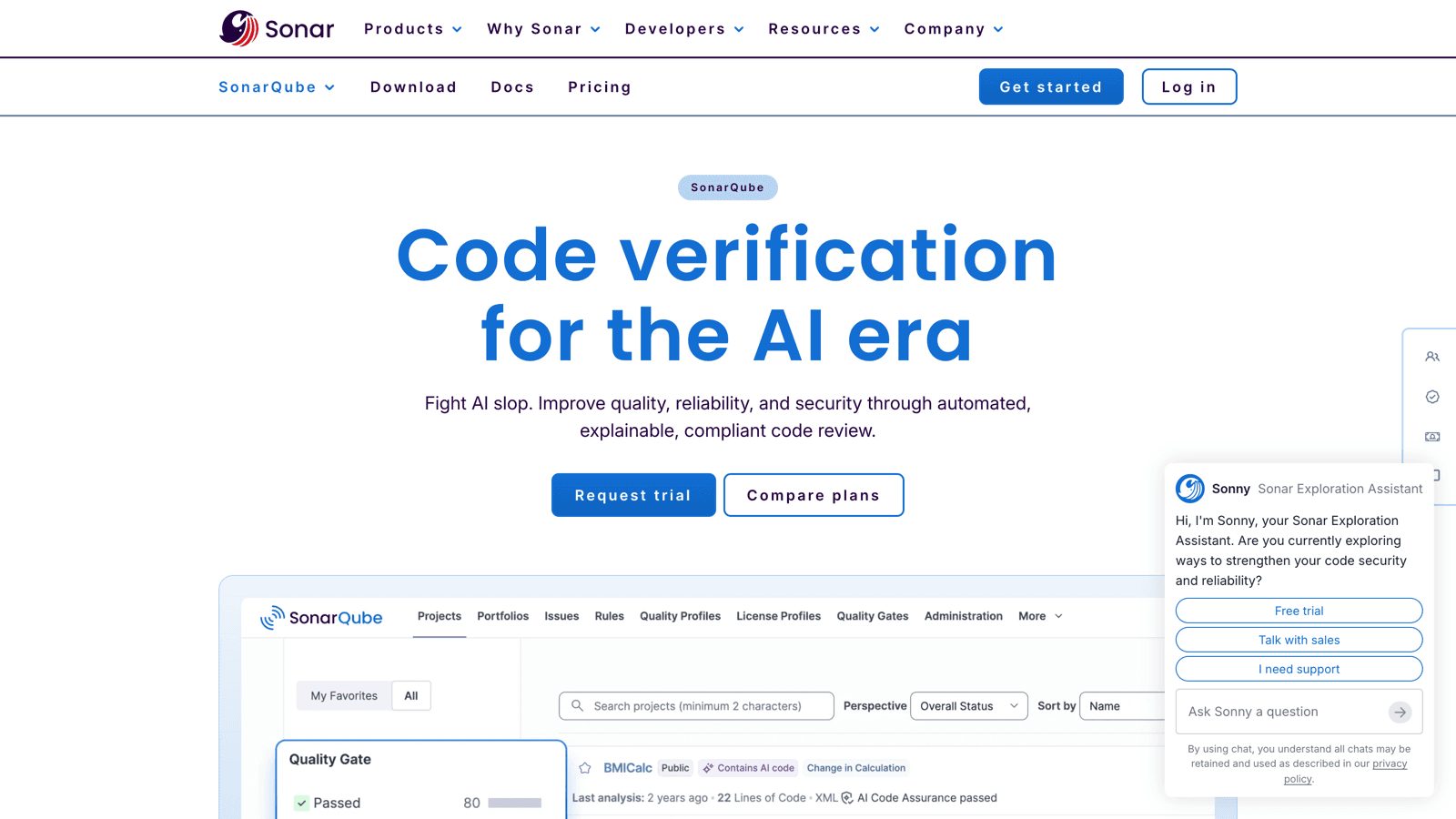
The engine is deep on static analysis. Sonar publishes a 3.2% false-positive rate, “7,000+ distinct types of issues detected” on its IDE page, and per-language rule counts that reach 650-plus for Java and C++, all organized under the Clean Code attributes of consistent, intentional, adaptable, and responsible.
Security sits inside that static frame. Built-in SAST plus taint analysis ship in the core product, while SCA, dependency-aware Advanced SAST, SBOM, and license policy live behind the paid Advanced Security add-on, and Sonar’s own docs confirm no DAST, IAST, or penetration testing anywhere in the platform.
How much does SonarQube cost?
SonarQube Cloud Team starts at $34 per month for up to 100k lines of code, with increments available up to a 1.9M LOC ceiling, and SonarQube Server Developer starts at $750 per year priced per instance. Both meters are per line of code with unlimited users, and a free Community Build (21 languages), a 50k-LOC free Cloud tier, and free analysis for public repositories cover the entry point.

The friction is what happens above 100k LOC. Sonar publishes no LOC-to-price bands, no calculator, and no Enterprise figure, so the cost is genuinely hard to forecast, and a PeerSpot reviewer described a jump to “$15,000 per one million lines.” Hard quality gates add a second complaint, with a banking reviewer on Capterra warning they “may block delivery/deployment if hard gates are enabled.” The alternatives below each answer a different one of these gaps: the LOC cliff, the missing dynamic testing, or the absent pentest.
The 13 Best SonarQube Alternatives at a Glance
Here is the full field, ranked with CodeAnt AI first for developer fit, then grouped from code-security platforms through DAST, exposure management, and pentest-as-a-service.
# | Tool | Category | Starting paid price | Standout vs SonarQube in 2026 |
|---|---|---|---|---|
1 | CodeAnt AI | AI code review + SAST + agentic pentest | $24 / user / mo | Static review plus real, pay-per-exploit pentesting, per seat not per LOC |
2 | Aikido Security | All-in-one AppSec + AI pentest | $350 / mo (flat) | Code-to-cloud coverage on a flat fee, no LOC meter |
3 | Astra Security | PTaaS + DAST + cloud scanning | $199 / mo (scanner) | Human and AI pentests that test the running app |
4 | Codacy | Code quality + AppSec | $18 / dev / mo | Same quality gates, priced per seat with unlimited LOC |
5 | DeepSource | AI code review + SAST/SCA | $24 / user / mo | Hybrid static-plus-AI engine, five-minute setup |
6 | StackHawk | DAST for developers | $10 / user / mo | Runtime exploit proof inside the coding agent |
7 | Intruder | Vulnerability and exposure management | $239 / mo (annual) | Covers the internet-facing estate code scans miss |
8 | Cobalt | Pentest as a service | Custom (credit-based) | Human testers find chained flaws no scanner sees |
9 | Synack | Premium crowdsourced PTaaS | From $4,181 / pentest | Vetted red team plus FedRAMP Moderate |
10 | NodeZero (Horizon3.ai) | Autonomous network pentest | Custom | Proof of exploit across network, cloud, and identity |
11 | Pentera | Automated security validation | Custom | Agentless estate validation, ingests SonarQube findings |
12 | XBOW | Autonomous AI pentester | $4,000 / test | Working web and API exploits, priced to a manual pentest |
13 | Hadrian | Agentic EASM + pentest | €3,000 / test (Nova) | Continuous external attack-surface testing |
The 13 Best SonarQube Alternatives in 2026
Every tool below is judged against what SonarQube actually does and does not do: read code statically, bill per line, and stop short of running the app or attacking it. Each section carries the vendor’s own pricing next to SonarQube’s in the middle column, a real screenshot, and at least one third-party review so no claim rests on marketing copy alone.
1. CodeAnt AI
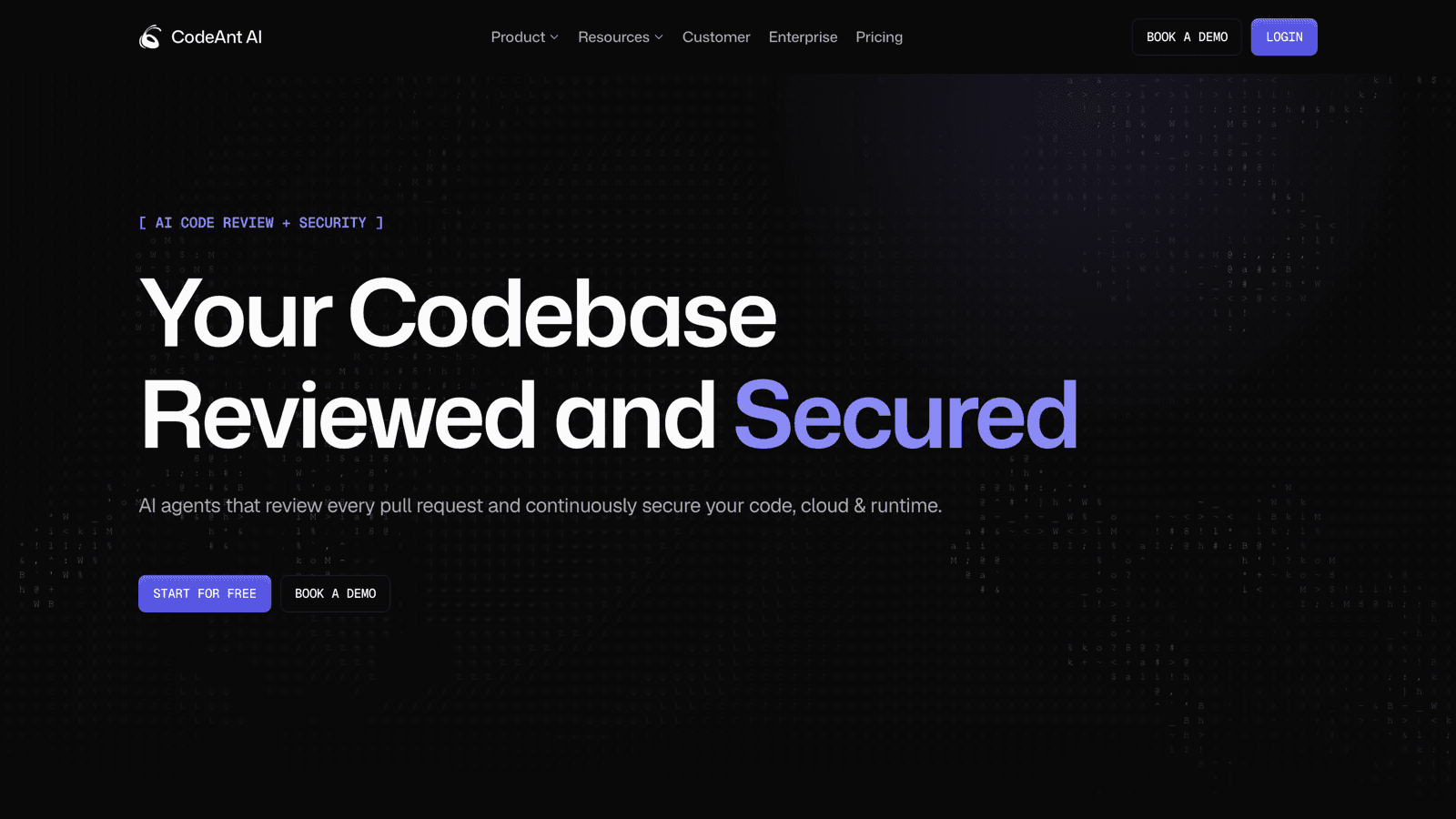
CodeAnt AI is the best SonarQube alternative for developers in 2026 because it keeps the static review a SonarQube user relies on and adds the two things SonarQube confirms it does not do, dynamic testing and real penetration testing, on one login and a per-seat price.
Where SonarQube stops at a CVSS score and a quality gate, CodeAnt’s agentic pentest returns a working exploit or nothing at all. Jeson Patel, CTO at Series B startup 11x, said it “went deeper than any penetration test we’ve ever commissioned,” after production runs surfaced 3.2M patient records through an unauthenticated API and 6M passenger records via a broken-object-level-authorization chain.
Features of CodeAnt AI
The static checks a Sonar gate enforces, with no add-on. AI code review, SAST, SCA, secret detection, and IaC run inline on every pull request across 30-plus languages, so SCA is included rather than gated the way SonarQube parks it behind Advanced Security.
Exploit proof where SonarQube stops at severity. Agentic pen testing and DAST chain attack paths against the running app and hand back a 48-hour report, turning a theoretical finding into a working exploit or nothing.
Reach past the repository SonarQube reads. CSPM, container scanning, VM scanning, and cloud threat detection extend coverage into cloud and runtime, ground a static code engine never inspects.
A per-seat bill instead of a per-LOC meter. AI code review runs $24 per user per month on annual billing, so cost tracks headcount rather than climbing with every line the way SonarQube’s Cloud tiers do above 100k LOC.
Bitbucket and Azure DevOps native, matching Sonar’s SCM breadth. GitHub, GitLab, Bitbucket, and Azure DevOps connect directly, alongside VS Code, Cursor, Windsurf, and IntelliJ.
Free for public code, like Sonar’s OSS tier. Open-source repositories get the full platform at no cost, with a 14-day trial and unlimited seats for private teams.
Pros of CodeAnt AI
Review feedback that reads past a rule ID. A Gartner Peer Insights reviewer in IT services called the feedback “highly accurate” and useful “for pointing out issues with edge cases, missed logic, and even mundane things that are easy to miss like naming inconsistencies and copy/paste errors.”
Connects to the SCM SonarQube users on Bitbucket wrestle with. An engineering director on G2 called it “one of the few tools which works with BitBucket” and credited it with cutting “considerable time to review PR.”
Security findings a pre-merge scan would not surface. A Product Hunt reviewer noted the team has “been helpful in finding important security issues,” and a Scoutflo user described an “Aha moment the minute our Github PRs were summarised after installation.”
Cons of CodeAnt AI
A shorter track record than a decade-old incumbent. CodeAnt carries 4.8 on G2 and 4.7 on Gartner but a smaller review base than SonarQube’s years of Capterra and PeerSpot history, so weigh the trial over the star count.
Occasionally more cautious than a tuned Sonar profile. A mid-market reviewer on G2 noted suggestions can feel “too cautious or sometimes it needs manual adjustments, also onboarding takes time.”
Not the single deepest static rule library. SonarQube publishes 650-plus rules for Java alone across 40-plus languages, so a team chasing raw static rule count weighs that against CodeAnt’s defensive-plus-offensive span.
CodeAnt AI vs SonarQube pricing
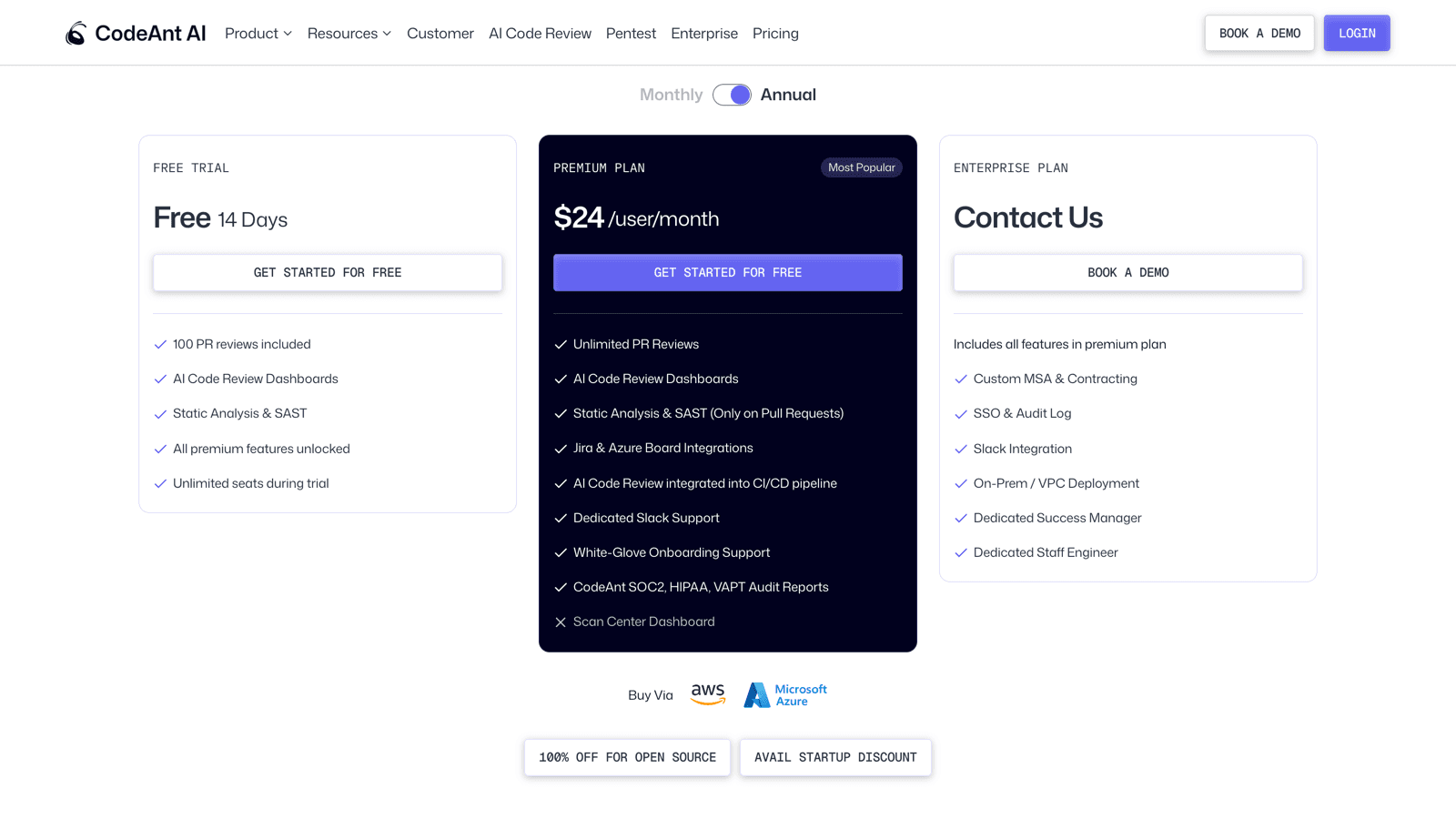
What’s included | SonarQube | CodeAnt AI |
|---|---|---|
Entry paid price | $34 / month (Cloud Team, up to 100k LOC) | $24 / user / month (AI code review, annual) |
Free option | Community Build, 50k-LOC free Cloud tier, free for public repos | 100% free for open source, plus a 14-day trial with 100 PR reviews |
Pentest / DAST | Not offered | $0 engagement fee, pay only for exploitable High and Critical findings, 48-hour report |
Billing unit | Per line of code, unlimited users | Per user for review, outcome-based for pentest |
Self-hosted | Server Developer from $750 / year, per instance | Available on Enterprise |
Best for: teams that want SonarQube-style static review plus real dynamic testing and pentesting in one platform, without a per-line-of-code bill.
2. Aikido Security
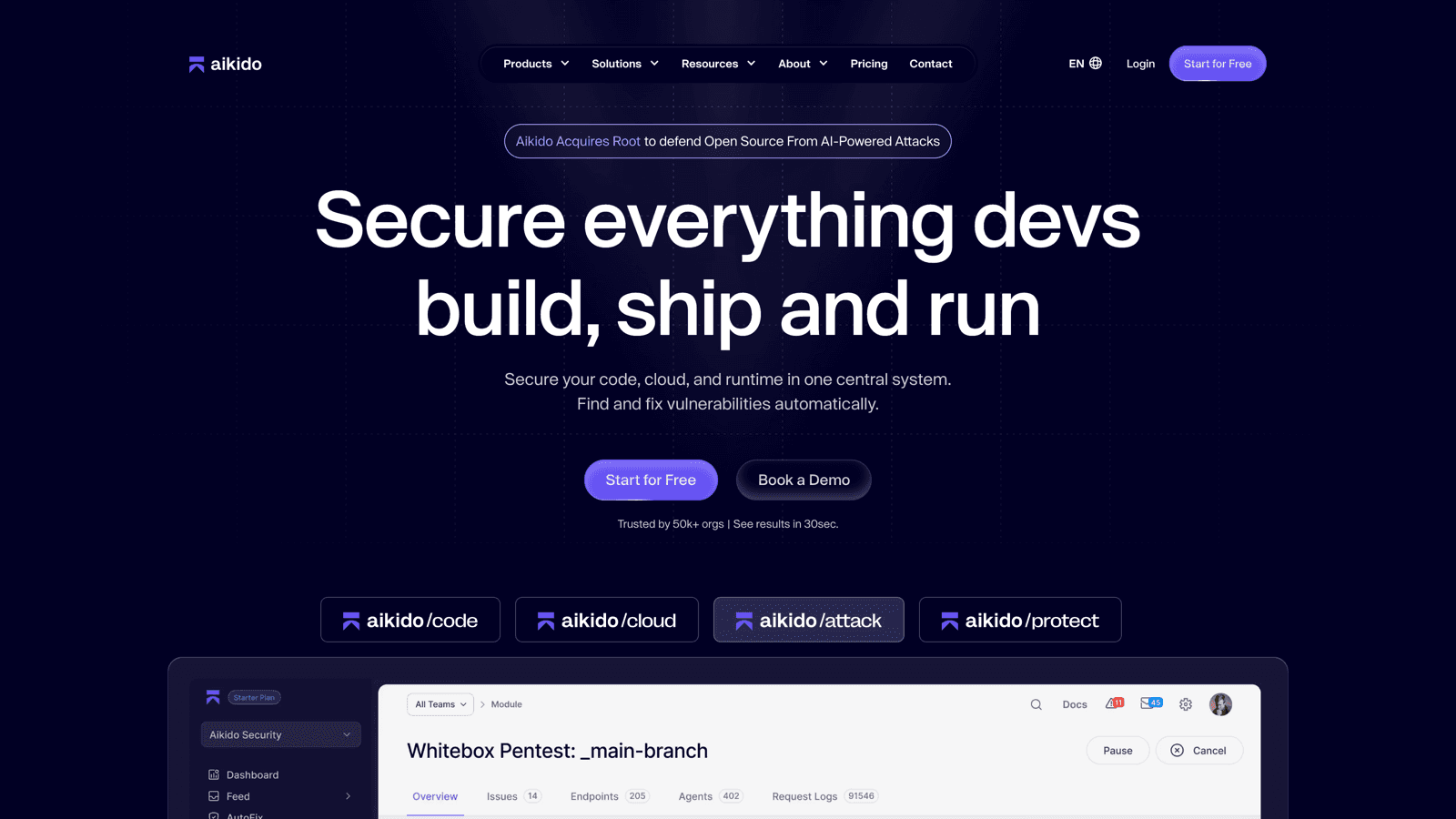
Aikido Security answers the SonarQube user who is tired of paying per line and of bolting on separate tools for cloud and offensive testing. It runs SAST, SCA, secrets, IaC, CSPM, container scanning, DAST, and AI pentesting from one dashboard on a flat monthly fee.
Sonar names Aikido on its own comparison library, and the pitch cuts the other way for a Sonar buyer. Where SonarQube gates SCA and Advanced SAST behind an Enterprise-only add-on, Aikido folds dependency, cloud, and pentest coverage into the base platform.
Features of Aikido Security
Four products where SonarQube ships one static engine. Aikido /Code, /Cloud, /Attack, and /Protect span SAST, SCA, secrets, IaC, cloud posture, DAST, and runtime, covering the code-to-cloud path Sonar stays out of.
SCA and cloud in the base fee, not an Enterprise upsell. Dependency scanning, container, and CSPM ship without the Advanced Security tier SonarQube parks SCA behind.
Autonomous pentesting SonarQube has no answer for. Agents map exploitable routes across code, containers, and cloud into attack graphs and return “results in hours rather than weeks,” proving reachability a static scan only guesses at.
A flat fee that ignores line count. Paid tiers bundle 10 users with caps on repos and containers, so a growing codebase never trips a per-LOC price band.
Pros of Aikido Security
The quiet a noisy Sonar backlog rarely delivers. Cornelius at n8n, quoted on Aikido’s pricing page, said “with 92% noise reduction, we got used to ‘the quiet’ quickly.”
Onboarding at a scale a Sonar rollout rarely matches. Marc Lehr of GEA is quoted on the enterprise page that “in just 45 minutes, we onboarded 150+ developers with Aikido.”
One dashboard instead of the tool sprawl around a lone SAST engine. A vCISO on the pricing page described the pain Aikido targets, that “in one environment, for AppSec alone, we had six different tools.”
Cons of Aikido Security
Less static depth than Sonar’s rule engine. The Opengrep and Semgrep-fork ruleset trades SonarQube’s 7,000-plus issue types and published per-language rule counts for noise reduction.
No Clean as You Code gating model. Aikido has no equivalent of the new-code quality gate many teams standardize their CI on with SonarQube.
Bundled-seat caps rather than open per-LOC scaling. Paid tiers fix 10 users plus hard caps, and extra seats move to custom pricing.
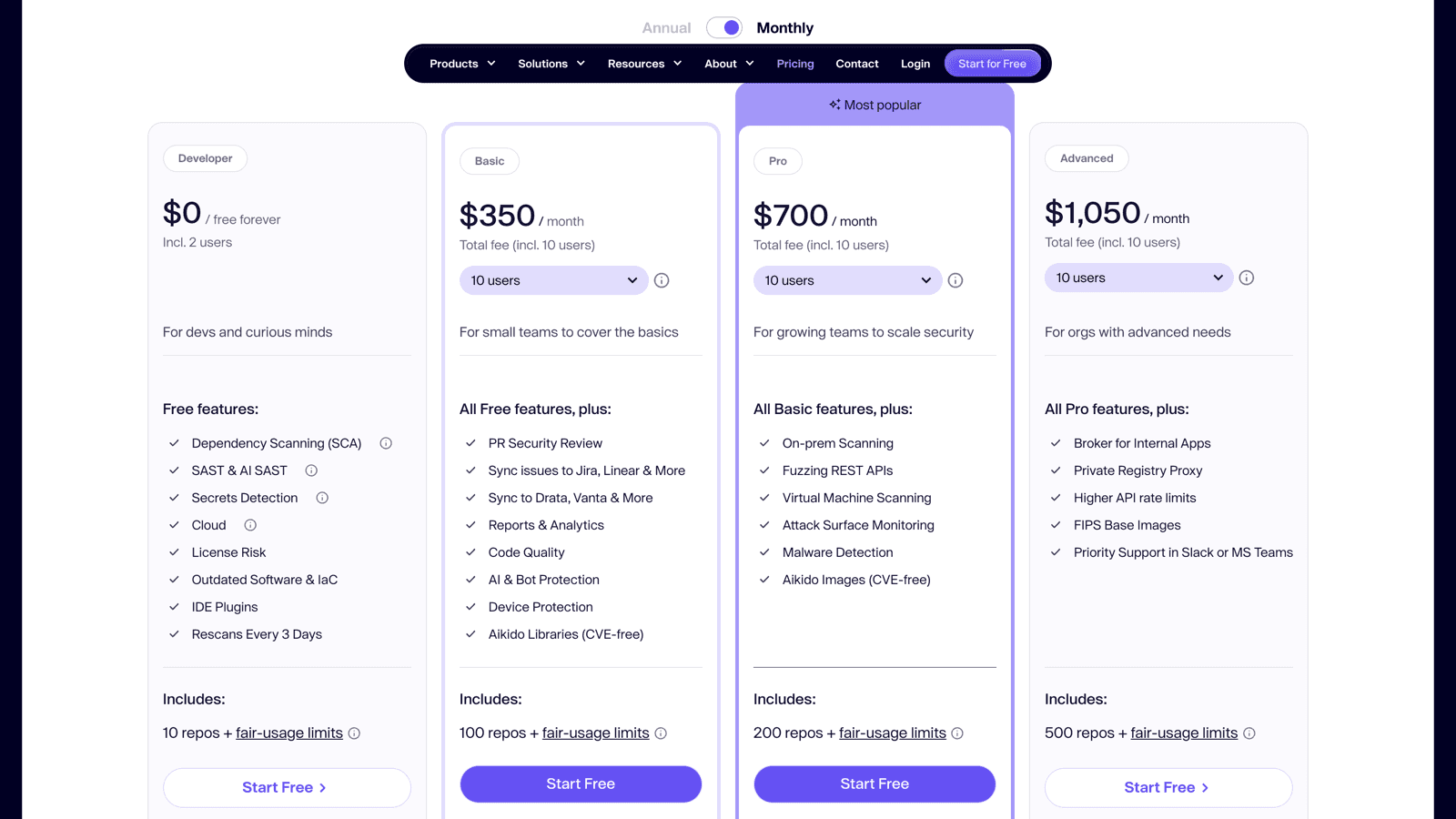
Aikido Security vs SonarQube pricing
What’s included | SonarQube | Aikido Security |
|---|---|---|
Entry paid price | $34 / month (Cloud Team) | $350 / month (Basic, 10 users bundled) |
Free option | Community Build plus free public repos | Developer plan, 2 users, free forever |
Pentest / DAST | Not offered | DAST included, Standard Pentest €3,500 / $4,000 per assessment |
Billing unit | Per line of code | Flat fee plus caps on repos, containers, domains, cloud |
Annual discount | Monthly or annual (Cloud) | 10% off, up to 30% for startups |
Best for: teams that want code-to-cloud coverage and pentesting on a predictable flat fee, and can trade some static rule depth for breadth.
3. Astra Security
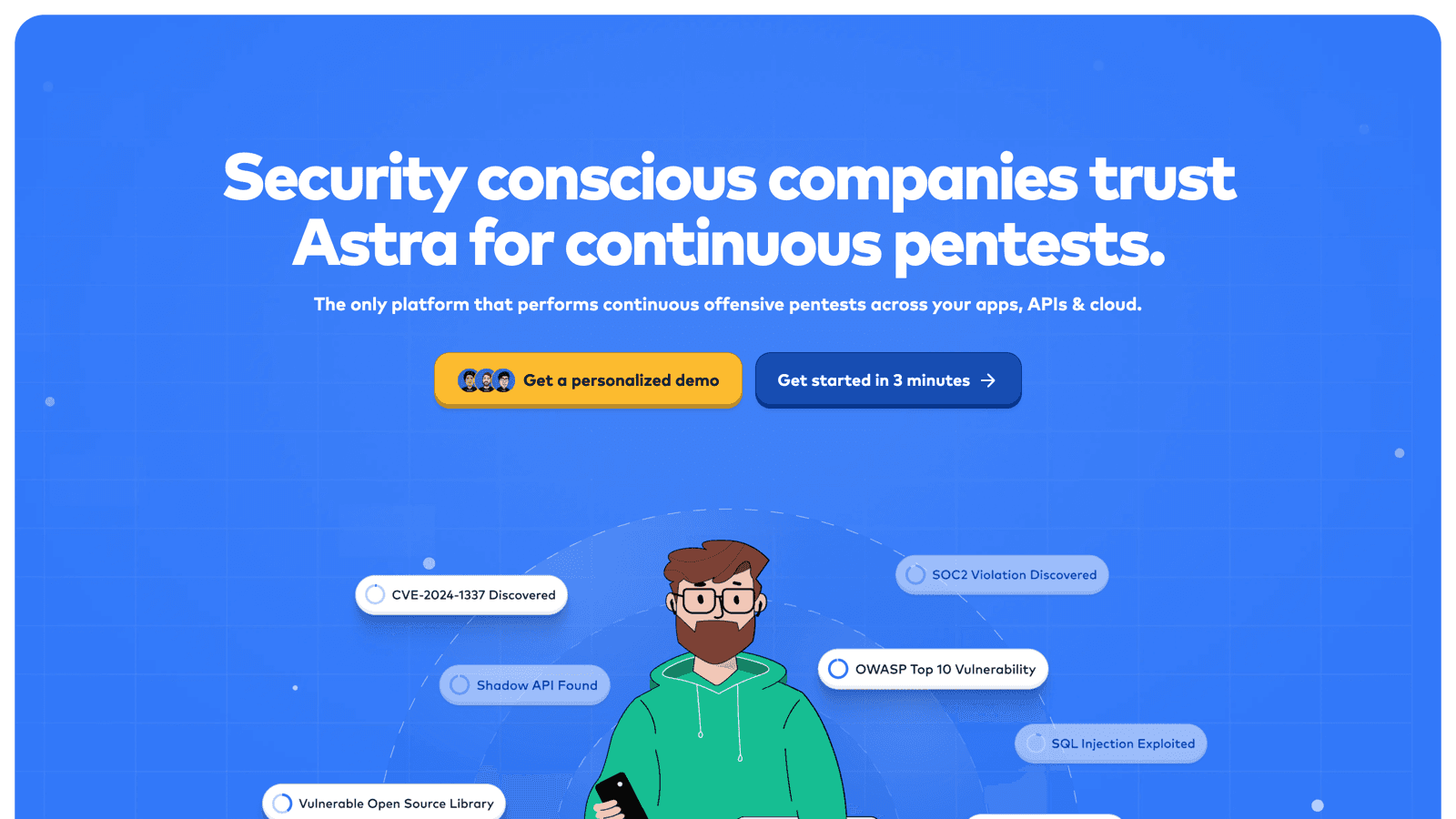
Astra Security attacks the exact seam SonarQube leaves open. Where Sonar reads code and never touches the running application, Astra blends an always-on DAST scanner with human, certified pentesters that test the live app, APIs, and cloud.
For a SonarQube team, Astra is a complement rather than a swap, adding the dynamic, exploit-proven results that a static engine cannot generate. Its AI fixes even arrive back in the IDE through an MCP integration.
Features of Astra Security
Human pentesters where SonarQube reads code alone. OSCP and CREST-certified testers threat-model and manually test after the automated scans, delivering the adversarial layer a static engine cannot.
A DAST scanner that hits the running app. More than 10,000 test cases cover the OWASP Top 10 with authenticated scanning behind login screens including TOTP-based MFA, exercising behavior Sonar only ever sees as source.
API and cloud discovery outside Sonar’s scope. Shadow, zombie, and orphan API detection plus 400-plus cloud misconfiguration checks across AWS, Azure, and GCP.
Fixes delivered to the IDE by MCP. A runtime finding returns a codebase-specific fix into Cursor, Claude Code, or Copilot, closing a loop a scanner-only workflow leaves open.
Pros of Astra Security
Easier to stand up than a self-hosted Sonar server. A Chief Business Officer wrote on Capterra that “the system is very simple and easy to use. The range of assessments done is very detailed.”
A real pentest at a fraction of a consultancy quote. An IT-services co-founder noted “the vulnerability scan is great but it was the manual pen test which was better,” adding “pen tests can be shockingly expensive and Astra is a very low price.”
Reporting an auditor accepts, which a code scan does not produce. A DevSecOps reviewer praised “the intuitive dashboard and real-time visibility into vulnerabilities” and “clear, actionable reports that made remediation easier.”
Cons of Astra Security
No SAST, so it cannot stand in for Sonar. Astra never scans source to find issues, only tests the deployed app, so it sits alongside SonarQube rather than replacing it.
Scanner precision still trails its manual testing. A financial-services security officer wrote on Capterra that “the accuracy of the automated scanner can be made more efficient.”
Some actions need a support ticket. A senior director noted “there are some actions that cannot be carried out in the UI and require contact to service.”
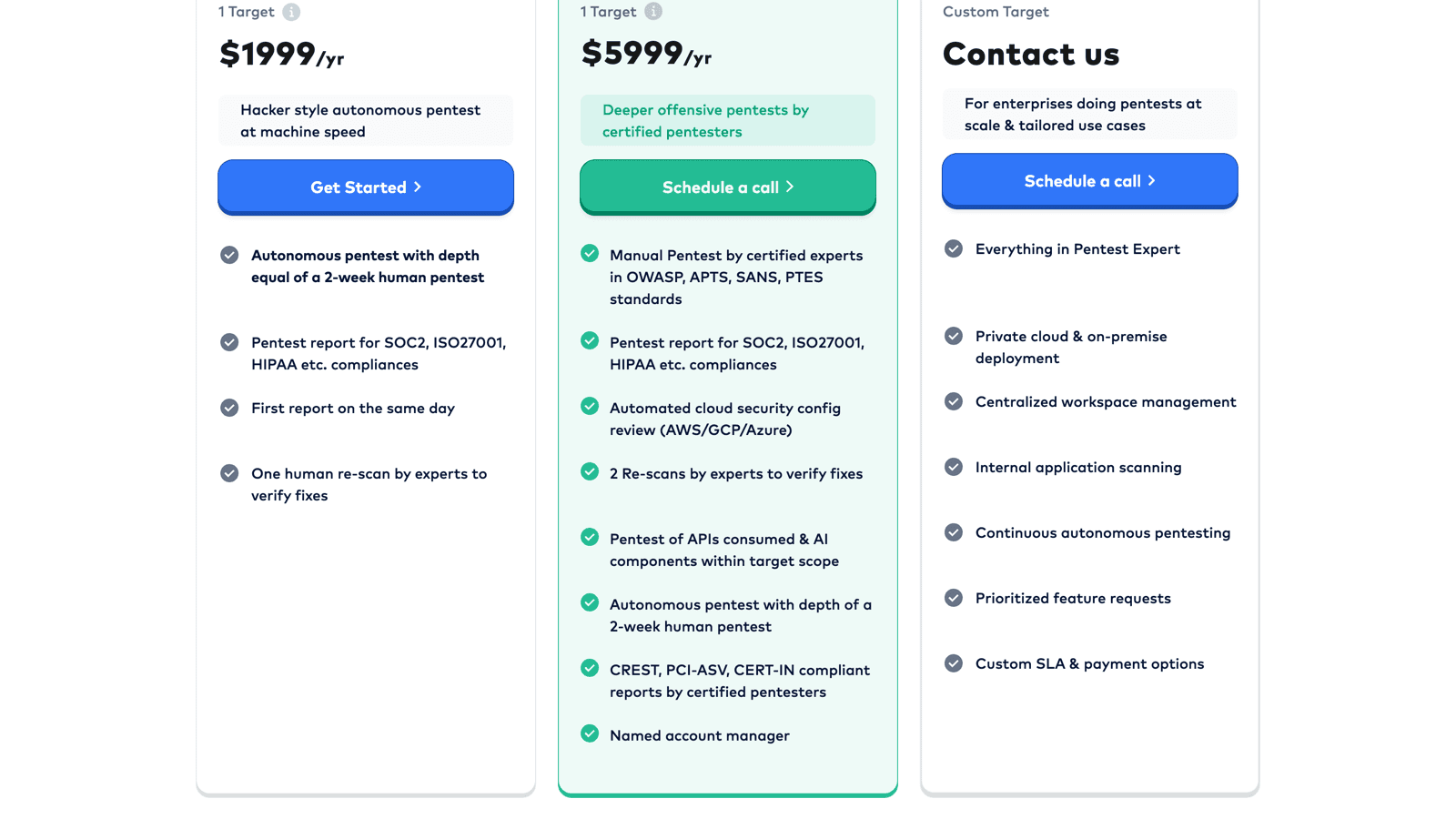
Astra Security vs SonarQube pricing
What’s included | SonarQube | Astra Security |
|---|---|---|
Entry paid price | $34 / month (Cloud Team) | $199 / month scanner, or $1,999 / year for a pentest |
Free option | Community Build plus free public repos | $7 one-week scanner trial, no free tier |
Pentest / DAST | Not offered | DAST included, Pentest Auto $1,999 / year, Pentest Expert $5,999 / year |
Billing unit | Per line of code | Per target (one app, its APIs, and cloud counts as one) |
SAST | Built-in, plus Advanced Security add-on | Not offered |
Best for: teams that keep SonarQube for static review and add a continuous, audit-ready pentest with a DAST scanner for SOC 2 and ISO 27001.
4. Codacy
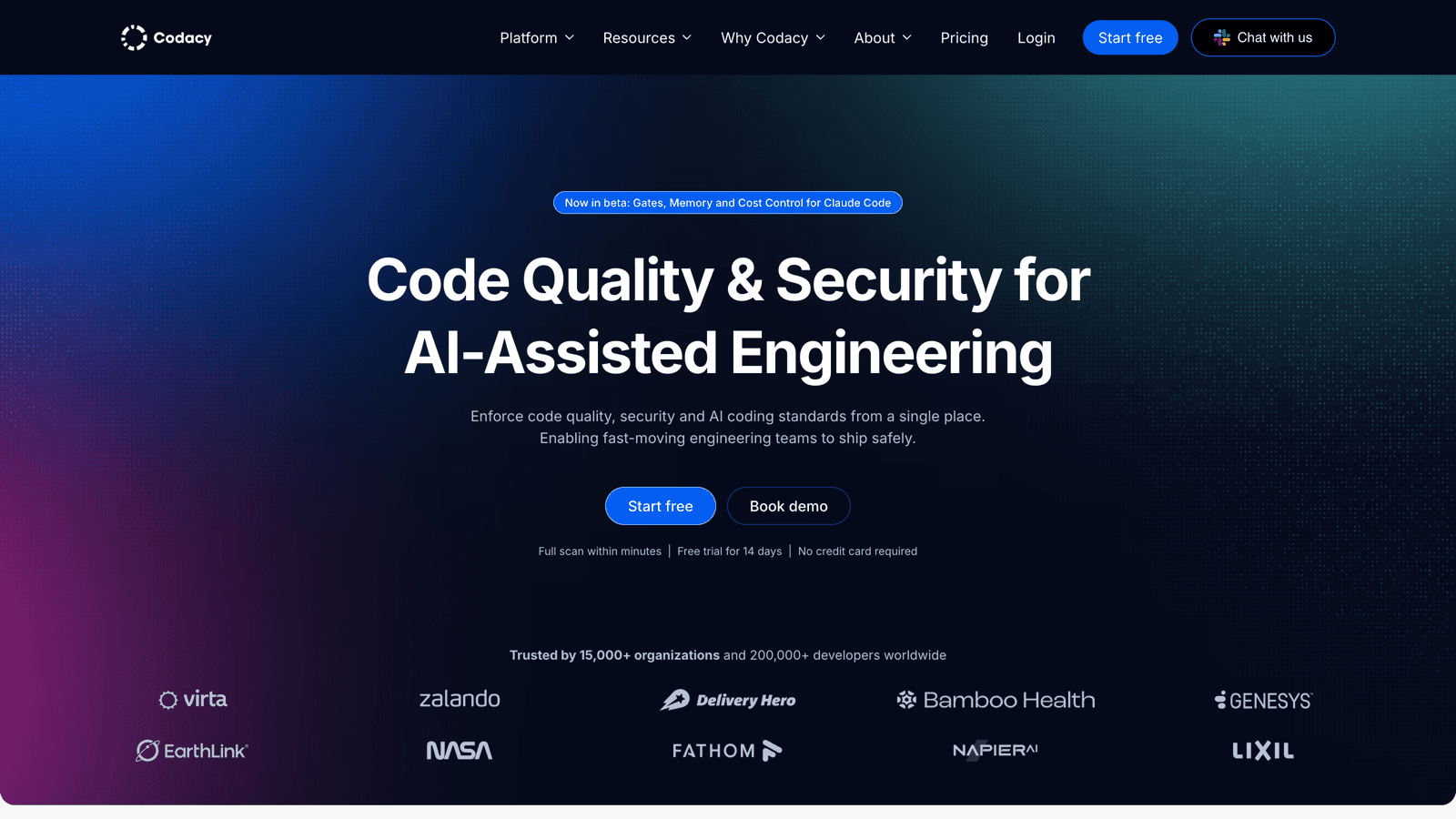
Codacy is the most direct like-for-like on SonarQube’s home turf of code quality and SAST, and it wins the argument on the exact pain point Sonar buyers name most, pricing. Codacy charges per developer seat with unlimited lines of code, so the LOC meter never bites.
The switch is a documented pattern rather than a claim. Daan van Leth of ihomer, quoted on Codacy’s pricing page, said “SonarQube’s pricing changed, so we needed an alternative that we could deploy across all projects.”
Features of Codacy
Quality gates a Sonar user recognizes, priced per seat. Over 12,000 scan rules span SAST, SCA, secrets, and IaC with org-wide coding standards, mirroring SonarQube’s gate model without the per-LOC meter.
DAST on the Business tier, which SonarQube never offers. App Scanning runs OWASP ZAP against staging web apps, OpenAPI, and GraphQL targets, testing the deployed app Sonar cannot.
Guardrails for AI code at the prompt, ahead of the merge Sonar checks. An MCP-driven IDE extension enforces rules across VS Code, JetBrains, Cursor, and Windsurf so agents open review-ready PRs.
An inventory of every AI model and MCP server in the repo. Automatic tracking mapped to EU AI Act and ISO 42001, governance a code-quality engine on its own does not carry.
Pros of Codacy
Faster to first report than a CI-plus-server Sonar setup. A retail CTO wrote on Capterra that Codacy “just takes a few mins to set up, and you start getting reports on a wide variety of languages. Leaves comments on PR’s for you.”
Ends the style-nit arguments a raw ruleset provokes. An IT-services CTO noted it “frees up Senior Resources to add value instead of arguing about casing and low level standards.”
A drop-in for teams leaving a legacy quality tool. A staff engineer in network security called it “a great alternative to Code Climate” with an on-prem option their team required.
Cons of Codacy
Cloud-hosted Git only, where Sonar Server runs anywhere. Codacy Cloud supports only cloud GitHub, GitLab, and Bitbucket, with Azure Repos still waitlisted.
A lighter security taxonomy than Sonar’s. Findings sort into 25-plus security categories against SonarQube’s 7,000-plus issue types and deeper per-language rules.
On-prem carries a premium and slower support. A staff engineer noted the on-prem solution is “2.5x more expensive than the hosted license per seat” and that support “is very slow to respond.”
Codacy vs SonarQube pricing
What’s included | SonarQube | Codacy |
|---|---|---|
Entry paid price | $34 / month (Cloud Team, up to 100k LOC) | $18 / dev / month (Team, annual) |
Free option | Community Build, free for public repos | Free Developer IDE plugin, plus free forever for open source |
Billing unit | Per line of code, unlimited users | Per developer seat, unlimited lines of code |
DAST | Not offered | DAST on Business, penetration testing billed separately |
Annual discount | Monthly or annual (Cloud) | ~14% off (annual vs monthly) |
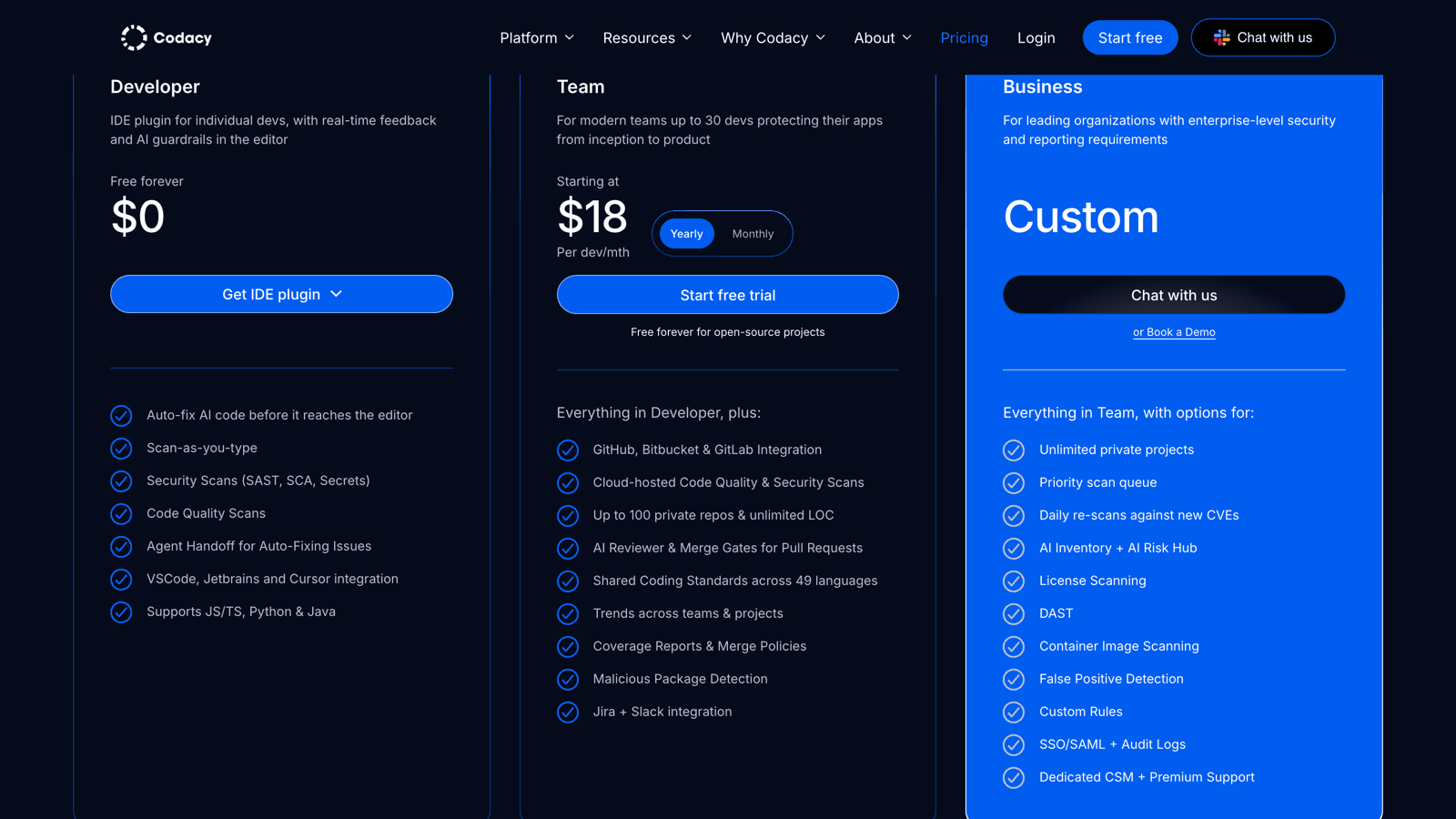
Best for: teams that like SonarQube’s quality-gate model but want per-seat pricing, DAST, and AI guardrails, on cloud-hosted Git.
5. DeepSource
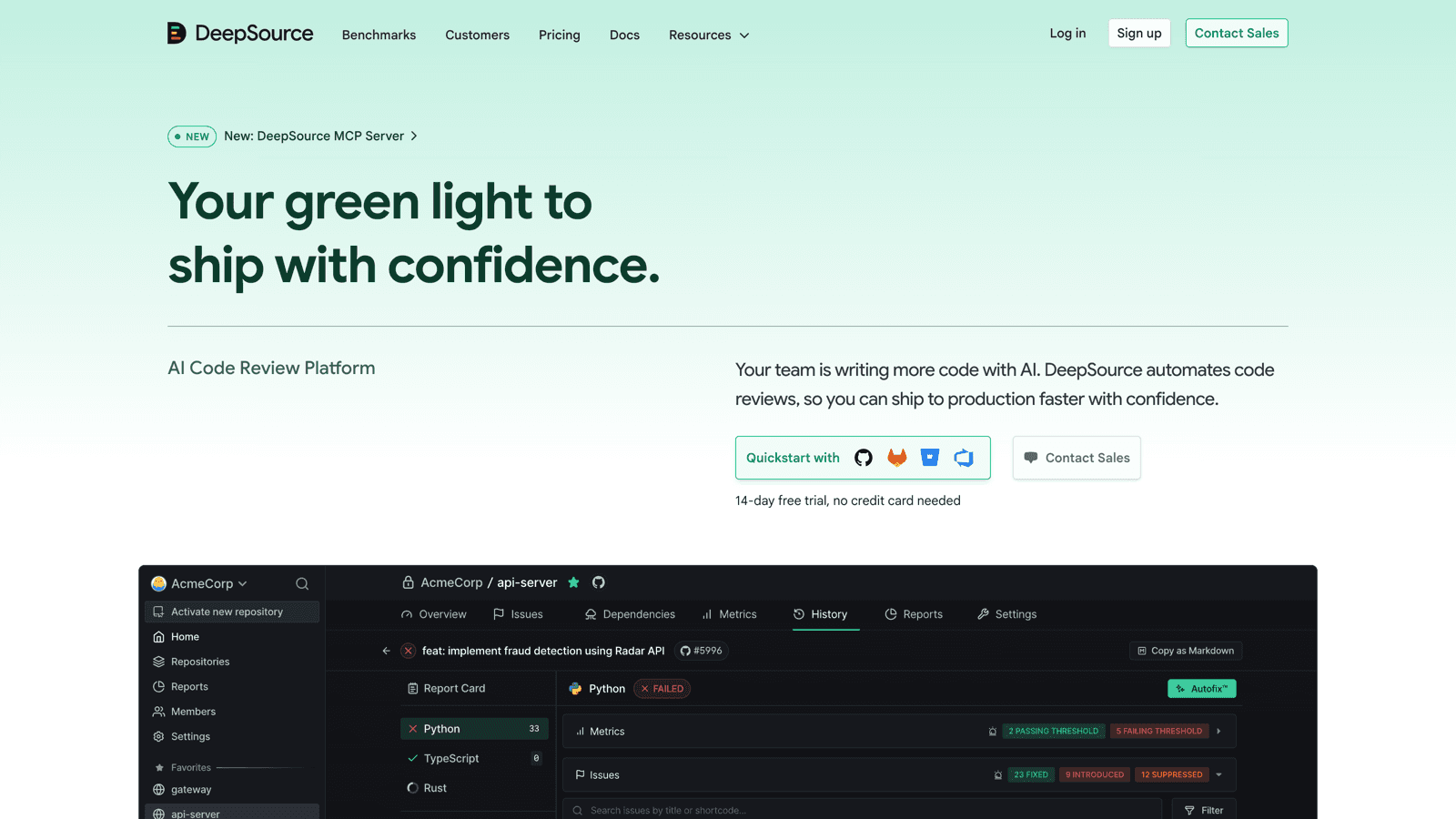
DeepSource is the closest philosophical match to SonarQube that still fixes the LOC bill. It runs deterministic static analysis, adds AI review on top, and prices per active committer at a published rate with a five-minute, no-CI setup, versus what its comparison page calls SonarQube’s “Requires CI + server.”
The wedge for a Sonar buyer is accuracy plus self-serve simplicity. DeepSource publishes an F1 score of 84.51% on a 165-CVE security benchmark and a per-seat price with no sales call.
Features of DeepSource
Deterministic rules plus AI, backed like Sonar’s findings. More than 5,000 rules across 30-plus languages run alongside AI Review, so results rest on rules rather than an LLM guess.
Autofix patches you approve as a diff. Verified, pre-generated fixes aimed at AI-written code, a step past the guidance a Sonar finding gives.
SCA that ranks by reachability, not raw CVSS. A Dynamic Risk score folds in EPSS and reachability to cut dependency noise by up to 60%.
Setup in minutes with no CI or server. DeepSource needs no pipeline where SonarQube “requires CI + server,” and bills per active committer rather than per line.
Pros of DeepSource
Line-precise findings with a fix attached. An embedded developer wrote on Capterra that “Code’s analysis is very complete and specific, pointing to the exact line with the issue. And It also can resolve them automatically.”
Connects to GitHub without the Sonar server plumbing. The same reviewer valued that “the feature of automatic linkage with the GitHub repositories is very useful and time saving,” and a data analyst praised “how simple the setup process was.”
Accuracy it invites you to measure. DeepSource publishes an F1 of 84.51% on a 165-CVE security benchmark, ahead of several AI reviewers it names.
Cons of DeepSource
Static and pre-merge only, the same ceiling as Sonar. DeepSource states on its own site it does not cover DAST or container scanning.
Narrower language reach than SonarQube. 30-plus languages and 5,000-plus rules trail Sonar’s 40-plus, and a Launch HN commenter pushed back with “when you offer support for C++, we’ll talk.”
Can flood a first run with findings. A full-stack developer wrote it “could generate a lot of input, which some engineers might find overwhelming.”
DeepSource vs SonarQube pricing
What’s included | SonarQube | DeepSource |
|---|---|---|
Entry paid price | $34 / month (Cloud Team) | $24 / user / month (Team, annual) |
Free option | Community Build, free for public repos | Free forever for open source (public repos) |
Billing unit | Per line of code | Per active committer |
AI review | AI CodeFix, Enterprise-gated on Server | Metered on top: $8 or $15 per 10k processed lines |
Pentest | Not offered | Not offered |
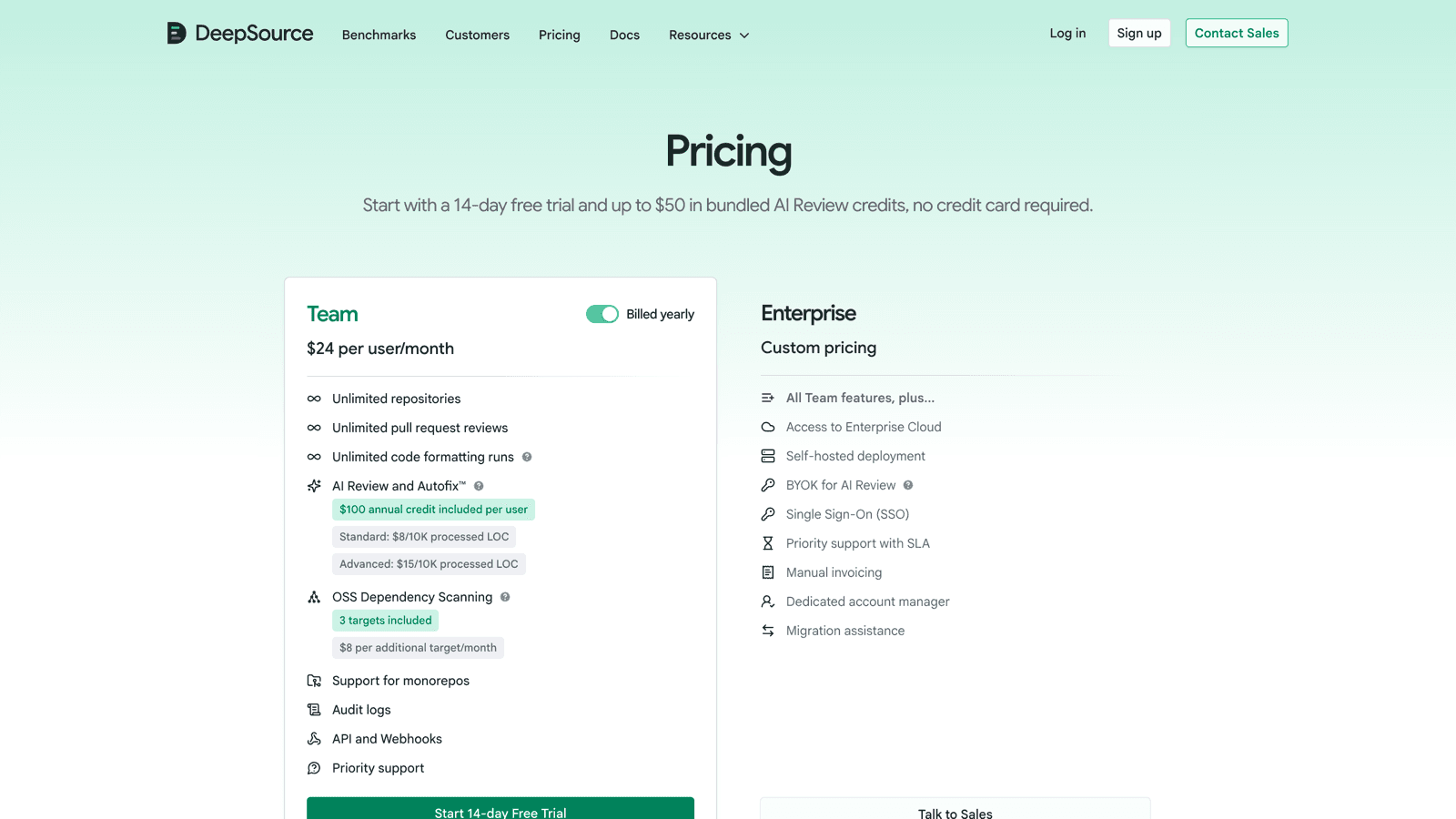
Best for: teams that want SonarQube-style static analysis plus AI review at a transparent per-seat price, and do not need dynamic testing.
6. StackHawk
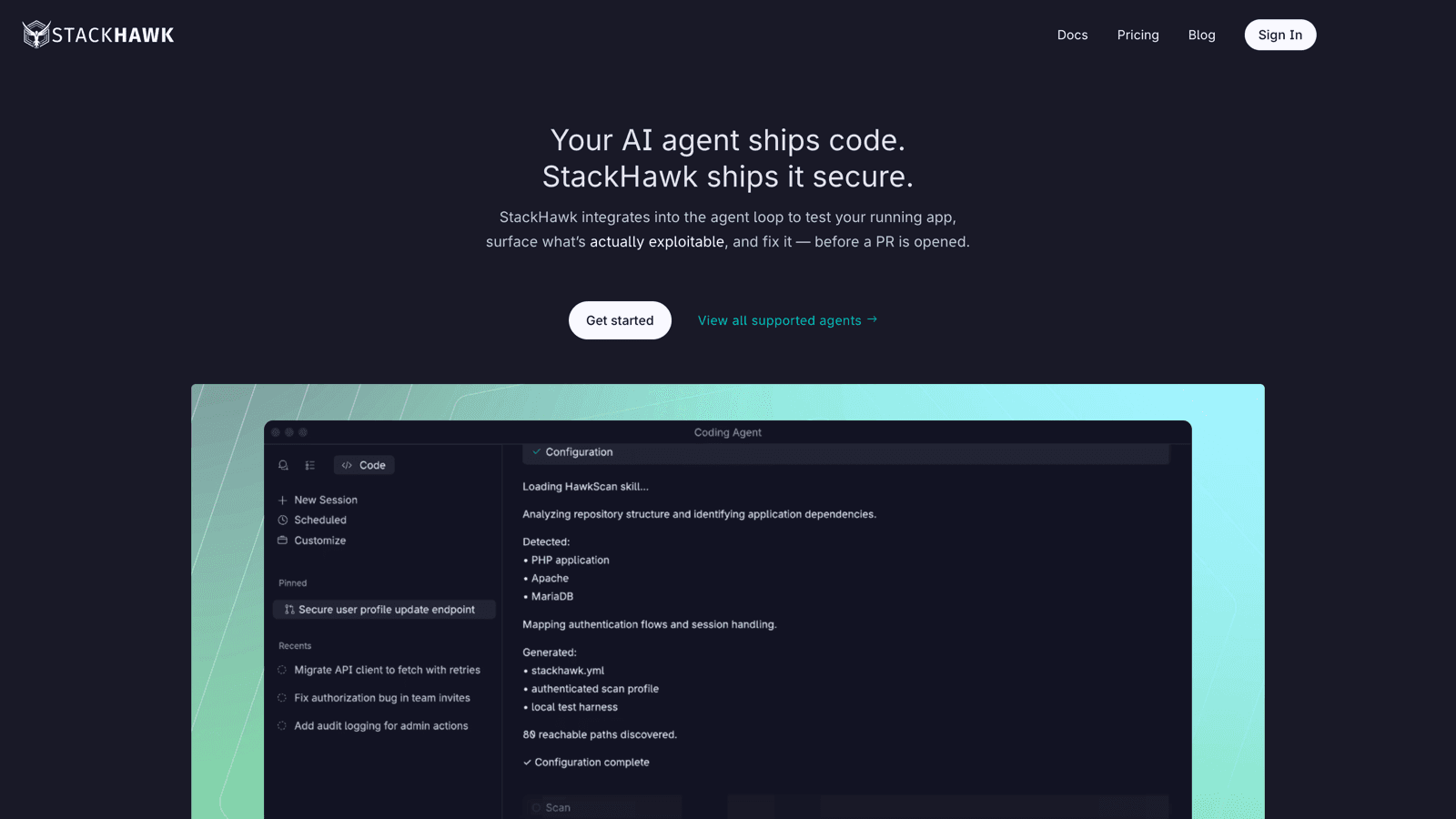
StackHawk is the sharpest answer to SonarQube’s structural limit. SonarQube reads code patterns, and StackHawk’s own DAST page puts the gap plainly, that “static analysis examines code patterns but can’t detect runtime vulnerabilities like authorization bypasses or business logic flaws,” which is exactly what StackHawk tests.
For a SonarQube user, StackHawk proves what is actually exploitable by hitting the running app over HTTP, then fixing and re-verifying inside Claude Code, Cursor, or Copilot before a PR opens. It is a complement to SAST, priced at coffee money per seat.
Features of StackHawk
Testing the running app SonarQube only reads. HawkScan hits a live app over HTTP with reproducible results, spun up per scan in CI from a versioned YAML config.
The auth and logic flaws a static engine cannot confirm. Coverage includes BOLA, broken function-level authorization, business-logic flaws, and mass assignment, runtime-only classes Sonar’s taint analysis never proves.
API and MCP surfaces from spec to scan. Native REST, GraphQL, gRPC, SOAP, and MCP-tool testing, with OpenAPI specs auto-generated from source.
Fix and re-verify inside the agent, ahead of the PR Sonar would gate. One install teaches Claude Code, Cursor, Codex, Antigravity, and Copilot to scan, remediate with source context, and rescan.
Pros of StackHawk
Pipeline integration cleaner than bolting DAST onto a SAST flow. A reviewer in computer software praised the “scanning capabilities and easy integration into CI/CD pipelines,” and another called onboarding “one of the best I’ve seen.”
Evidence of live exploitability, not a code smell. A security-operations manager valued the “ability to report any issues that may exist with code running live,” crediting it toward PCI certification.
A credible review base for a DAST complement. StackHawk holds 4.6 across 68 G2 reviews, confirmed through G2 and its AWS Marketplace syndication.
Cons of StackHawk
No SAST, so Sonar’s job stays untouched. StackHawk is DAST only and hands static analysis to Semgrep, Snyk Code, and CodeQL.
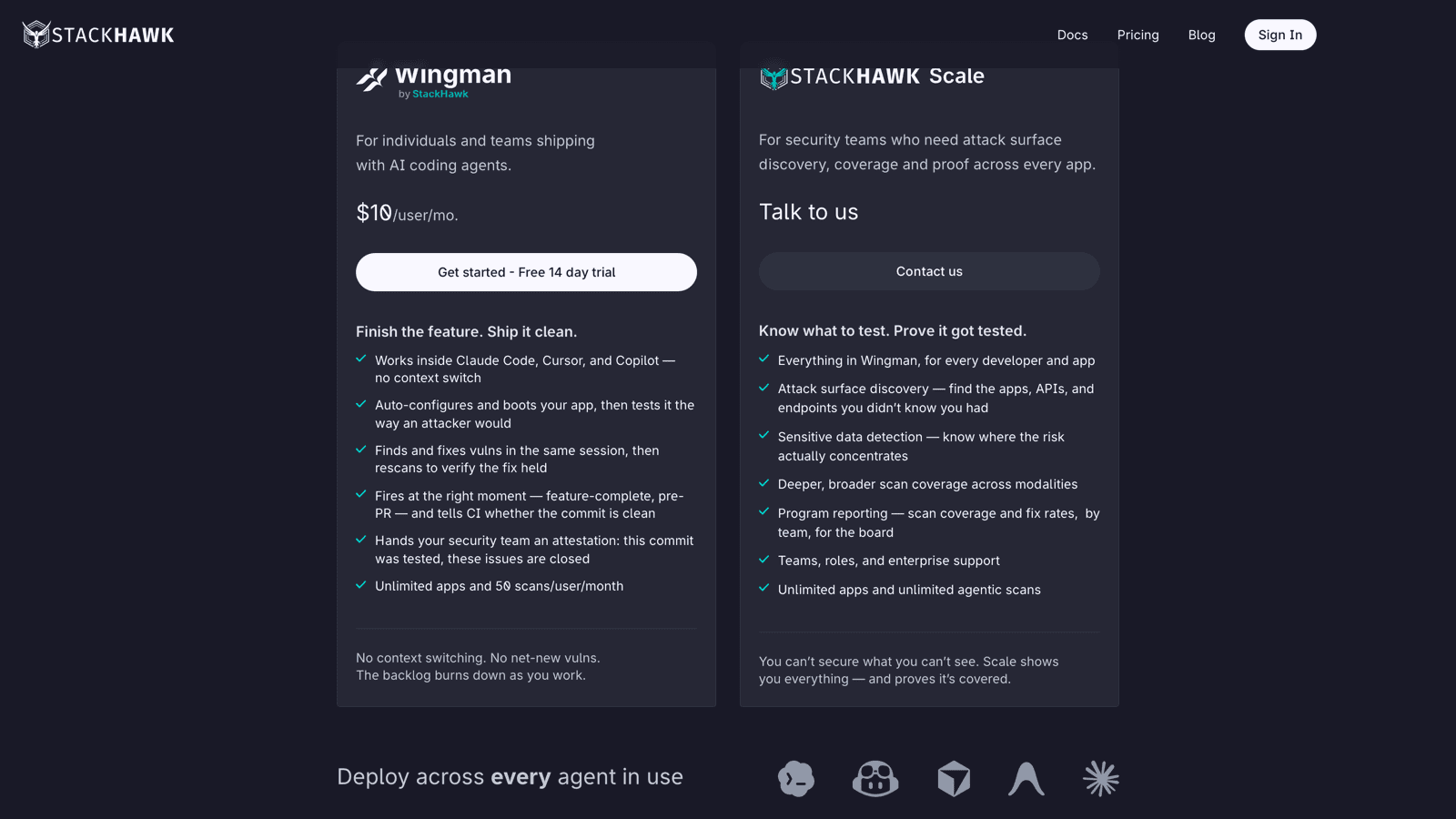
A monthly scan ceiling on the entry tier. Wingman caps 50 agentic scans per user per month before you buy more or move to Scale.
Authenticated scans take tuning. An AWS Marketplace reviewer noted “authenticated scans can be frustrating,” and a DevOps engineer said pipeline-dependency setup “needs refinement.”
StackHawk vs SonarQube pricing
What’s included | SonarQube | StackHawk |
|---|---|---|
Entry paid price | $34 / month (Cloud Team) | $10 / user / month (Wingman) |
Free option | Community Build, free for public repos | 14-day free trial, no permanent free tier |
Billing unit | Per line of code | Per user, unlimited apps |
Dynamic testing | Not offered | Core DAST, 50 agentic scans per user per month on Wingman |
SAST | Built-in | Not offered (integrates with SAST tools) |
Best for: teams running SonarQube for static review that want dynamic, exploitability-proven testing built into the coding agent for the price of a coffee per seat.
7. Intruder
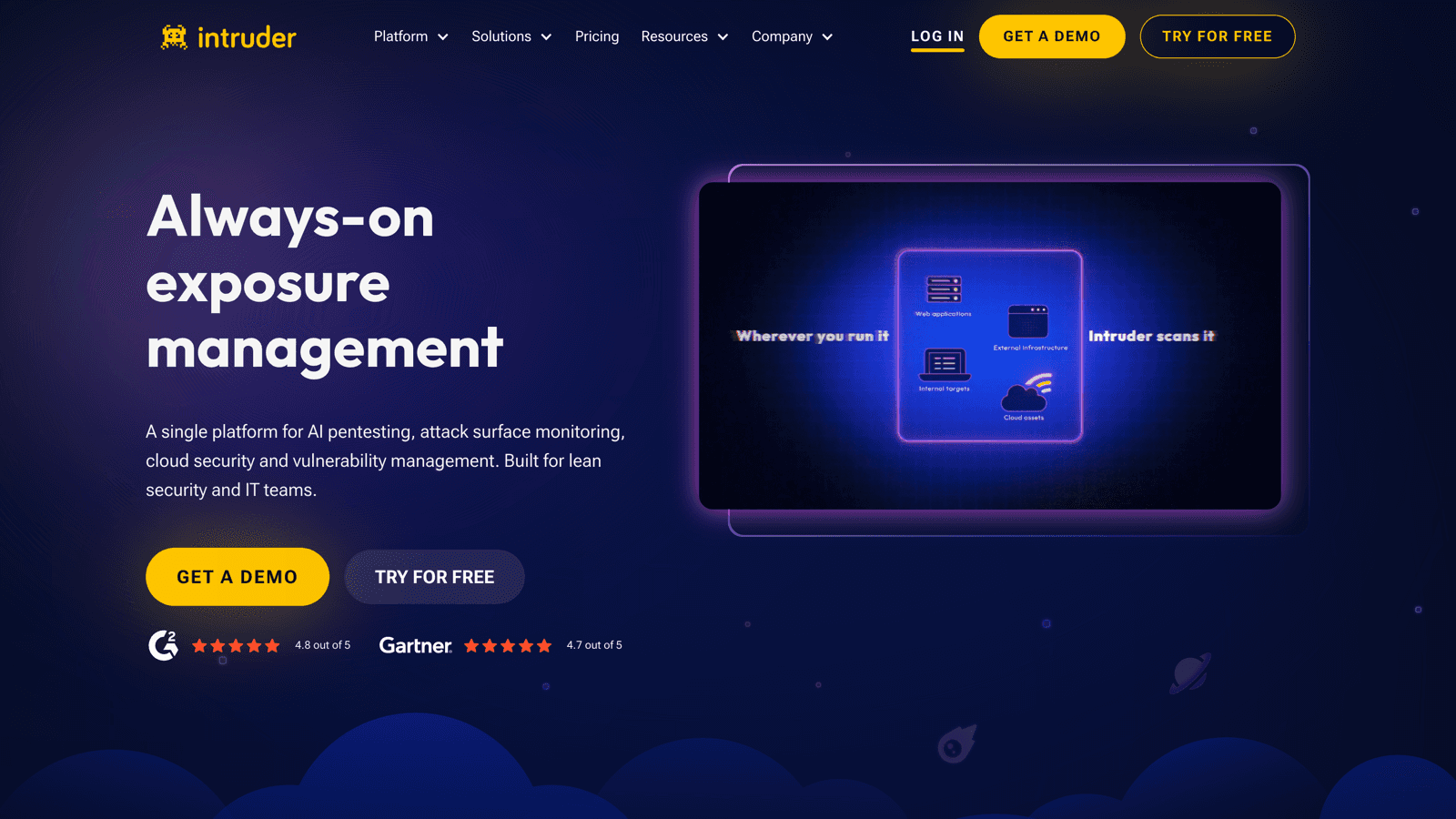
Intruder addresses the risk SonarQube can never see. SonarQube stops at the repository, while Intruder starts at the internet-facing estate, unifying vulnerability scanning, attack-surface monitoring, cloud security, and an AI pentest add-on for lean teams.
For a SonarQube user, that makes Intruder a layer, not a replacement, covering infrastructure and exposure that static code analysis has no visibility into. Its mission line is “to make cybersecurity accessible for the 99%.”
Features of Intruder
The internet-facing estate a code scan cannot see. Orchestrated OpenVAS, Nuclei, Tenable, and OWASP ZAP scanning under one dashboard, with Emerging Threat Scans within hours of a disclosure.
Continuous discovery of what changed outside the repo. Subdomain, exposed-service, and shadow-IT monitoring, with CloudBot auto-scanning new AWS, GCP, Azure, and Cloudflare assets.
A white-box pentest add-on that does read the repo. Connecting GitHub or GitLab returns an audit-ready web-app pentest from $3,500 per test, evidence Sonar’s static findings do not amount to.
An analyst that triages rather than dumps rules. GregAI prioritizes and validates findings and writes plain-language remediation, plus an MCP server for AI tools.
Pros of Intruder
Signal over the volume a scanner can bury you in. An operations director wrote on G2 that “rather than overwhelming us with low-value noise, it highlights vulnerabilities that genuinely matter and explains why they are important.”
Fast to start and broad enough to consolidate. An enterprise reviewer called it “our number one, 100% vulnerability assessment tool, replacing both Nessus open source and Tenable,” adding “the initial setup was super easy.”
A high-volume rating a niche code tool would envy. Intruder holds 4.8 on G2 across 207 reviews and made G2’s 2026 Best Software Awards.
Cons of Intruder
No repository scanning, so it never replaces SAST. Outside the pentest add-on, Intruder never analyzes source, unlike SonarQube’s core job.
Targets lock a licence for 30 days. A licence is consumed on scan and released only after 30 days of inactivity, which compounds across many targets.
Uneven cloud connectors. An enterprise reviewer noted “the Azure integration for Intruder is definitely still a little bit immature.”
Intruder vs SonarQube pricing
What’s included | SonarQube | Intruder |
|---|---|---|
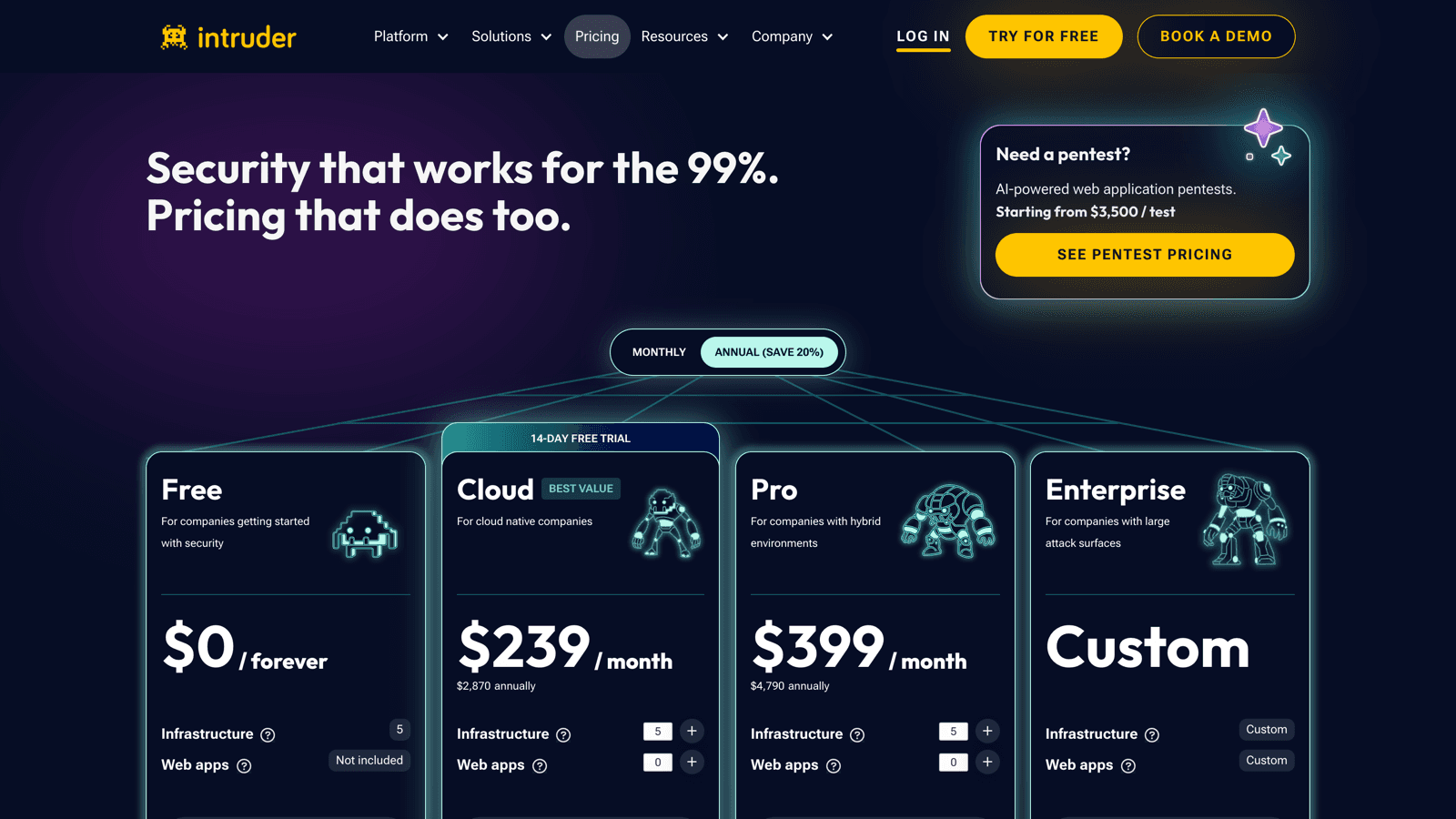
Entry paid price | $34 / month (Cloud Team) | $239 / month (Cloud, annual) |
Free option | Community Build, free for public repos | Free forever plan, 5 infrastructure licences |
Billing unit | Per line of code | Per licence (a target locks a licence for 30 days) |
Pentest | Not offered | AI pentest add-on from $3,500 per test |
Scope | Source code only | Internet-facing infra, cloud, web apps (no SAST) |
Best for: teams that keep SonarQube for code and add continuous vulnerability and attack-surface management for the infrastructure it never scans.
8. Cobalt
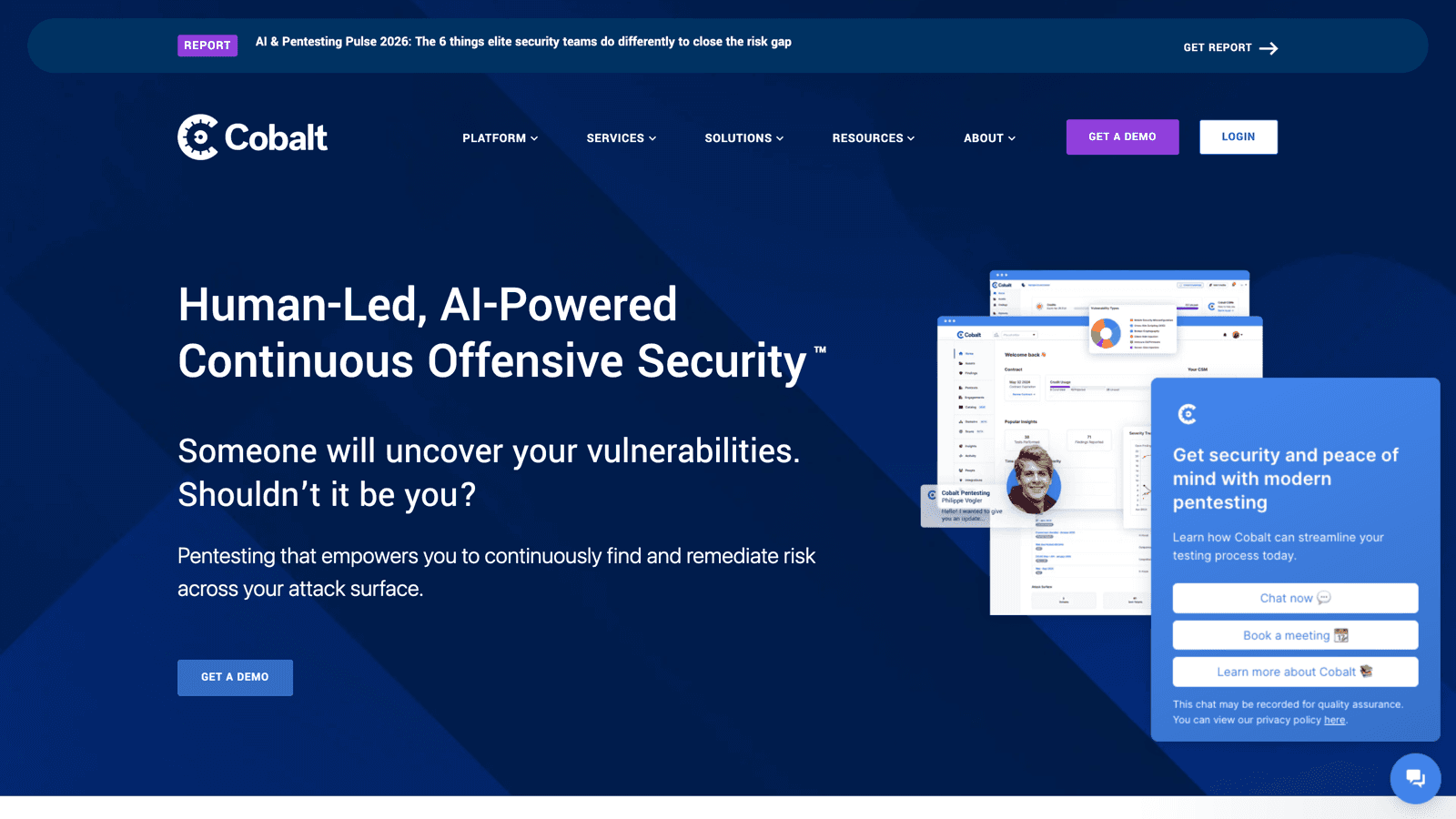
Cobalt gives a SonarQube team the one thing a scanner cannot manufacture, a real human pentest. SonarQube automates static review, while Cobalt pairs a SaaS platform with Cobalt Core, a vetted community of freelance pentesters who chain exploits and business-logic flaws.
The two sit at opposite ends of the same job. Cobalt even offers Secure Code Review as a hybrid SAST-plus-human service, a manual counterpart to SonarQube’s automated engine.
Features of Cobalt
Human testers where Sonar automates. Web, mobile, API, network, cloud, and AI/LLM pentests scoped in a four-step wizard over a standard 14-day period, work no static engine performs.
AI recon feeding human exploitation. Autonomous agents run discovery at machine speed while testers chain the exploits and business-logic flaws a source scan never surfaces.
Retesting that confirms the fix held. Free retesting of individual findings for 6 to 12 months with a 7-day retest SLA.
Secure code review as an expert service. A hybrid SAST-plus-human pass, a manual counterpart to the automated engine SonarQube runs, rather than a self-serve scanner.
Pros of Cobalt
Findings engineers can act on, not just triage. A senior staff engineer wrote on G2 that Cobalt delivers “actionable findings that are easy for engineers to understand and fix,” making security “collaborative rather than audit-driven.”
Onboarding smoother than standing up a program. A mid-market reviewer in SaaS healthcare said “Cobalt impressed me with their team’s responsibility and the smooth onboarding process.”
Tester quality that holds over years. A five-year customer noted the assigned pentesters “have been pretty solid for the discovery of findings and responsive,” with “reasonable” pricing.
Cons of Cobalt
A service, not the continuous scanner Sonar is. Cobalt’s code review is human-delivered, so it never covers the pre-merge automation SonarQube provides.
A five-credit floor on small scopes. A security specialist wrote on G2 he dislikes “that there is a minimum of five credits” for segmentation tests that need far less.
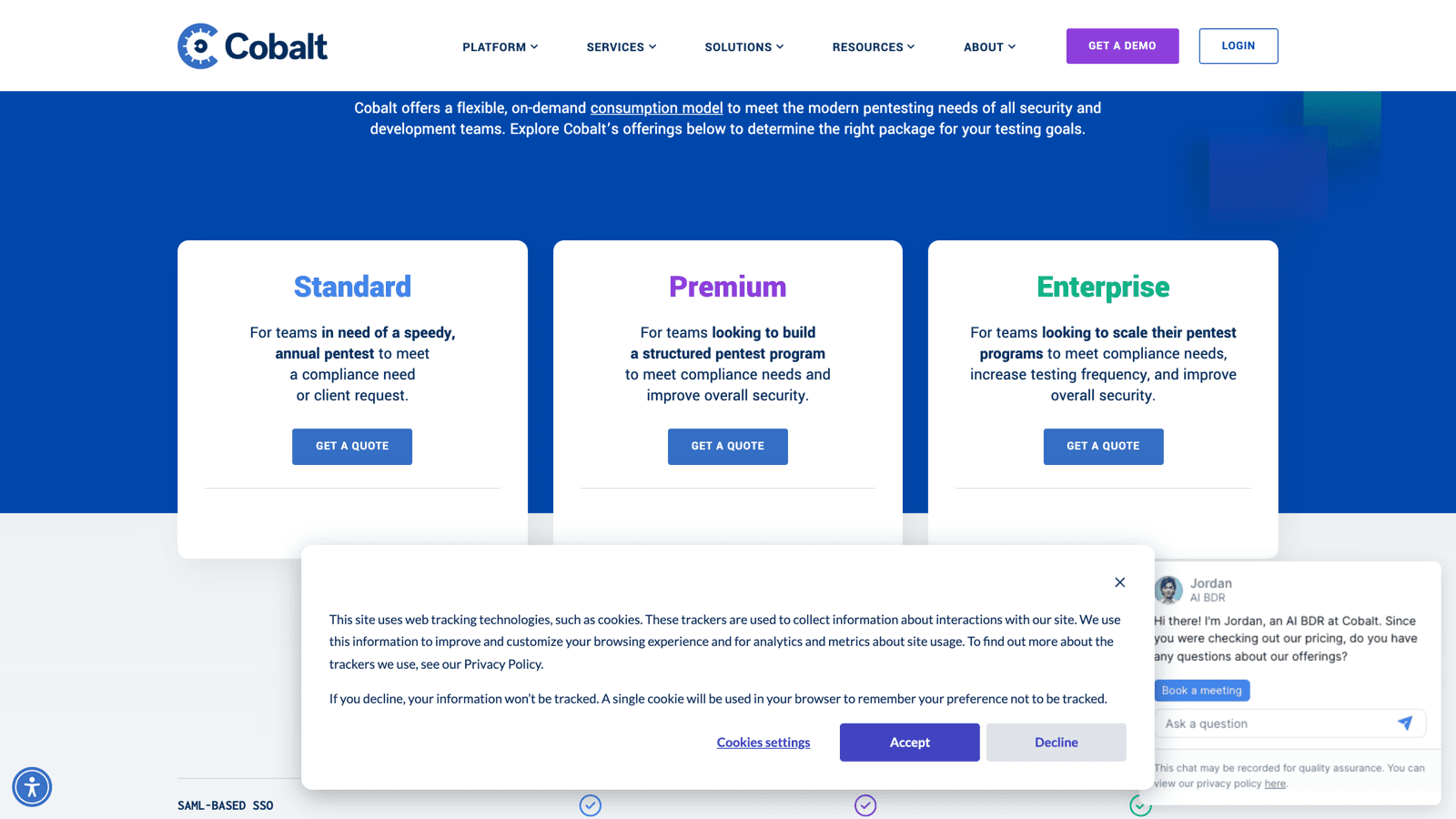
Annual, sales-gated credits. Packages are yearly, credits expire each contract term, and every tier is quote-only.
Cobalt vs SonarQube pricing
What’s included | SonarQube | Cobalt |
|---|---|---|
Entry paid price | $34 / month (Cloud Team) | Custom quote, credit-based |
Free option | Community Build, free for public repos | No free tier or trial |
Billing unit | Per line of code | Cobalt Credit (one credit is 8 hours of testing) |
Pentest | Not offered | Human-led, unlimited on-demand retesting |
SAST | Built-in continuous scanner | Human secure code review only |
Best for: teams that run SonarQube continuously and bring in human-led pentests when a compliance audit or client request demands exploit proof.
9. Synack
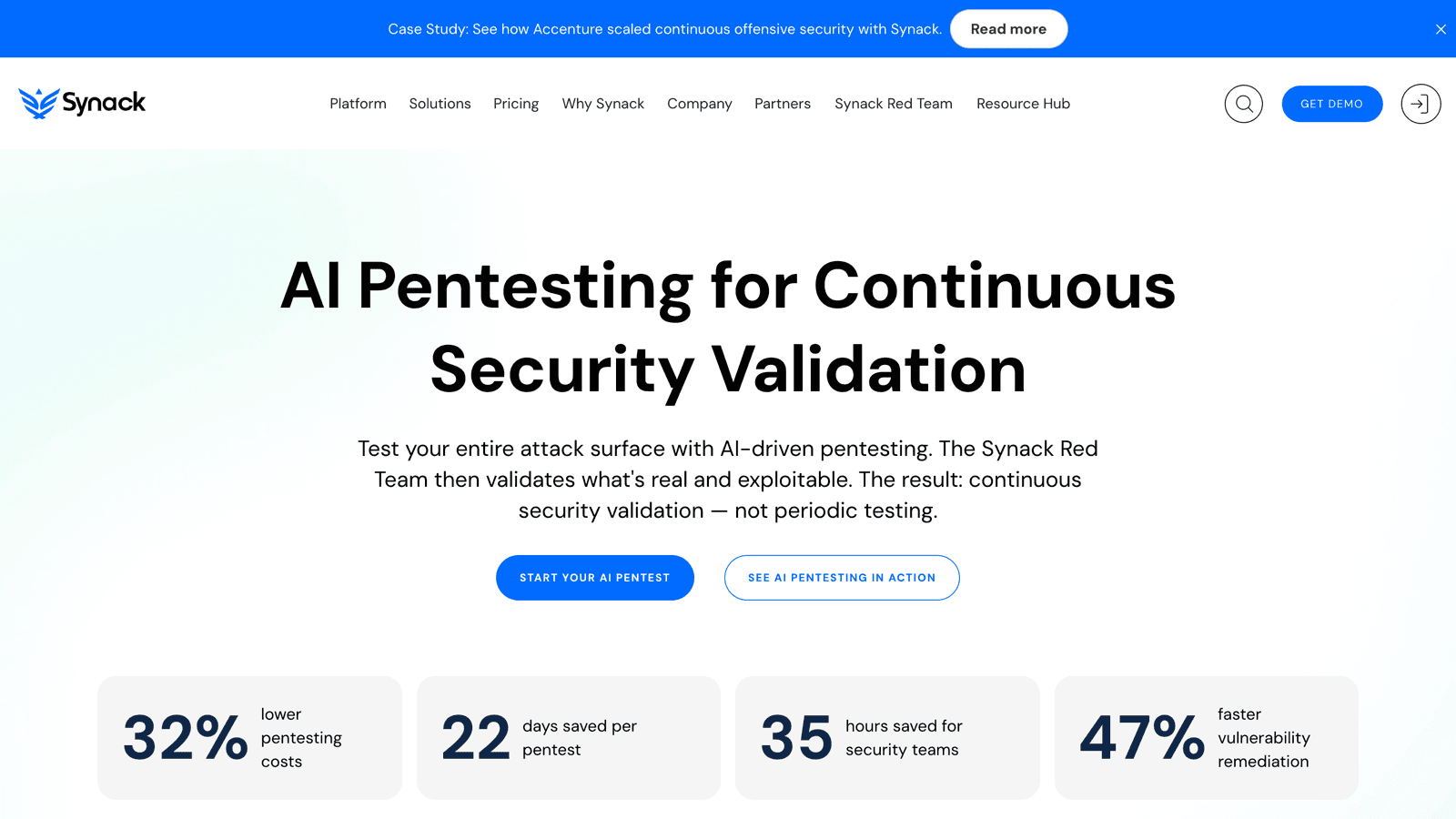
Synack sits at the premium, enterprise end of what SonarQube cannot do. It pairs Sara, an AI pentesting agent, with the Synack Red Team, a vetted community that accepts under 10% of applicants and runs government-grade background checks.
The contrast a Sonar buyer feels is drawn in Synack’s own review copy. A Synack customer on G2 valued that it looks for “unknown failures like logic flaws, insecure workflows, auth bypasses,” explicitly “unlike standard compliance checks like SAST scans.”
Features of Synack
A vetted red team on top of AI, where Sonar has neither. Sara expands coverage with agents, then the Synack Red Team validates what is real and exploitable, filtering 99.98% of scanner noise.
Continuous cadences across surfaces a code scan ignores. Synack14, Synack90, and Synack365 engagements span web, host, API, mobile, and cloud.
Federal-grade assurance a SAST tool does not carry. FedRAMP Moderate authorized, ISO 27001, and testing at DoD impact levels 4, 5, and 6.
Full traffic control over live testing. All work runs through the LaunchPoint VPN with packet capture and a one-click pause.
Pros of Synack
Researcher quality that finds what a scan does not. A principal technology architect wrote on Gartner Peer Insights, “I continue to be impressed with the quality of Synack’s findings, which speaks to the quality of their security researchers.”
Remediation detail that teaches, well past a rule ID. A reviewer on G2 said Synack “explains exactly how each flaw was exploited and provides a full detailed explanation on how to remediate,” calling it “like getting secure code training for free.”
Coverage broader than any single automated engine. A cyber-defense manager valued “a diverse pool of vetted researchers” giving “broader and more realistic coverage than traditional approaches alone.”
Cons of Synack
No SAST, and it says so by design. Synack is offensive black and grey-box testing only, disparaging code fuzzing as work it deliberately avoids, so Sonar’s static ground stays uncovered.
A platform subscription on top of the pentest price. Published test figures exclude a mandatory, separately quoted platform line item.
Enterprise budgets and commoditization pressure. A reviewer on G2 flagged “cost pressures” and a market that “has become more commoditized.”
Synack vs SonarQube pricing
What’s included | SonarQube | Synack |
|---|---|---|
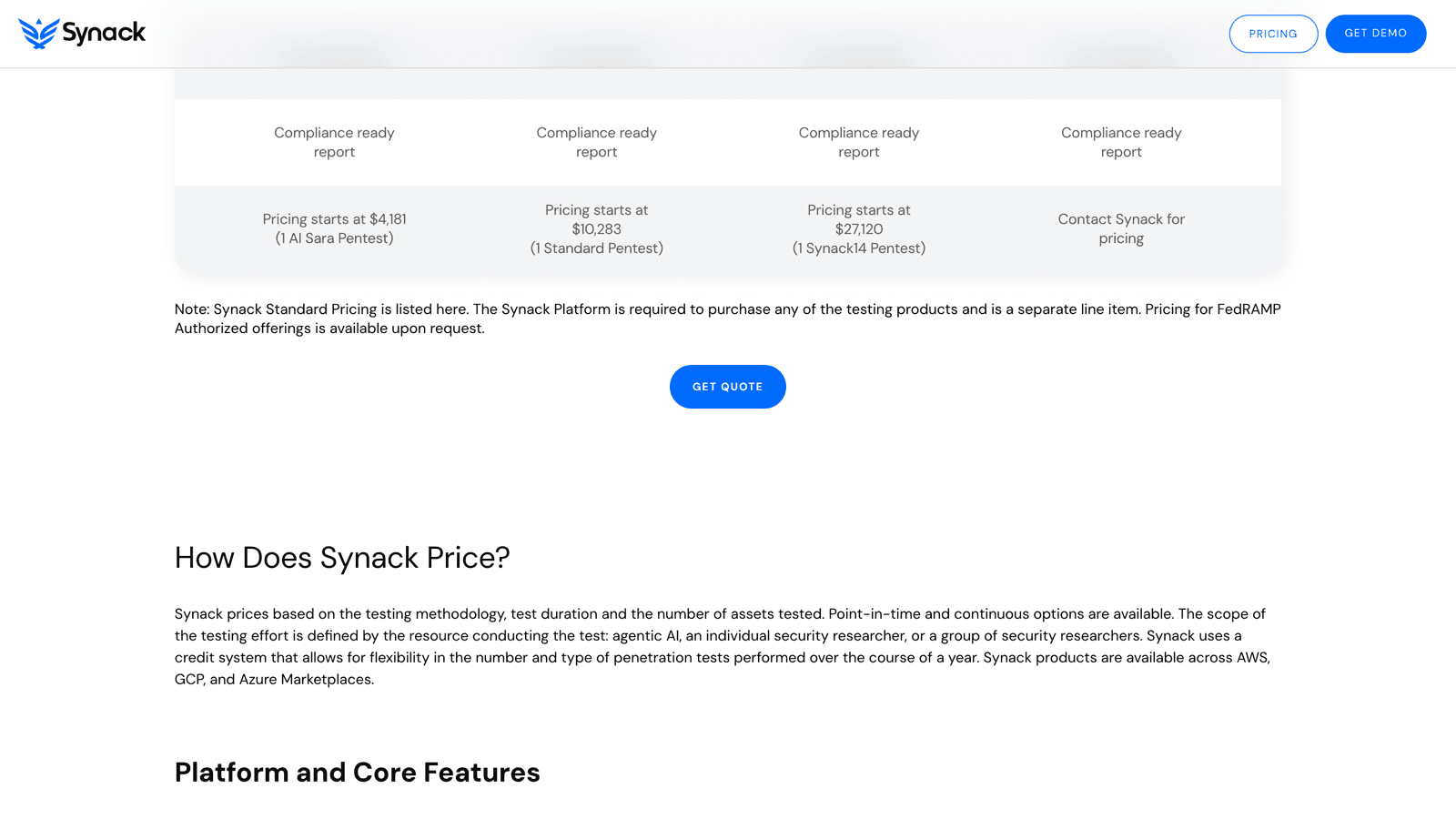
Entry paid price | $34 / month (Cloud Team) | From $4,181 per AI Sara pentest, plus a platform subscription |
Human pentest | Not offered | From $10,283 (SynackST) or $27,120 (Synack14) |
Billing unit | Per line of code | Prepaid credits, one-year expiry, via PO |
Free option | Community Build, free for public repos | Free Basic platform, tests still cost credits |
SAST | Built-in | Not offered |
Best for: enterprises and public-sector teams that keep SonarQube for code and need continuous, FedRAMP-grade validation from a vetted red team.
10. NodeZero (Horizon3.ai)
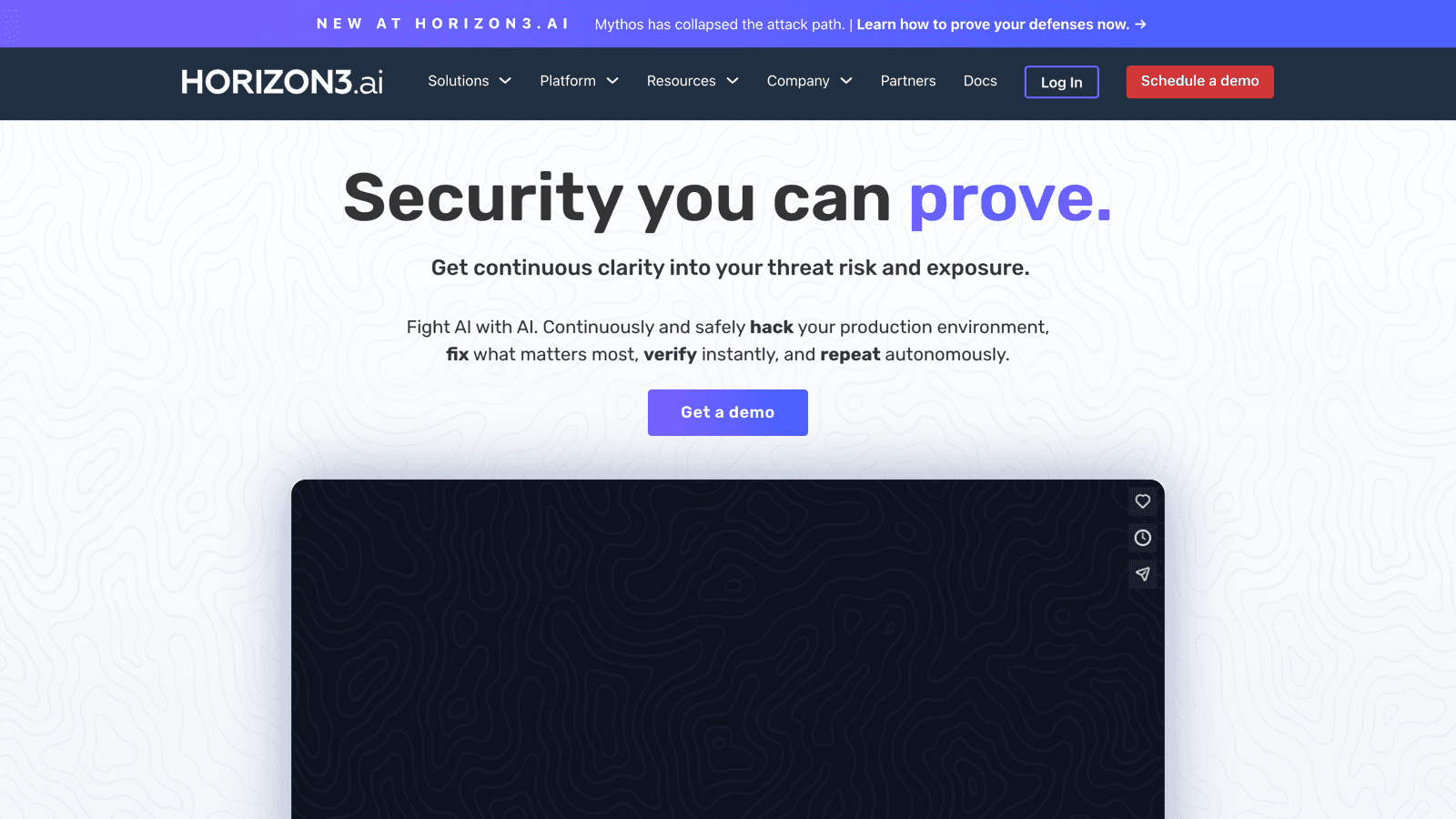
NodeZero from Horizon3.ai proves risk that SonarQube can only theorize about, one layer over. It runs autonomous penetration tests across the network, cloud, identity, and Active Directory, chaining real weaknesses into attack paths and confirming exploitability with evidence, safely in production.
Its slogan, “Security you can prove,” is a direct jab at CVSS-and-quality-gate thinking. NodeZero’s own line is that exploitability is “confirmed or ruled out with evidence, not vendor advisories or CVSS scores from vulnerability scanners that just check versions.”
Features of NodeZero
Proof of exploit where Sonar gives a severity score. Every finding ships with proof, impact, and a one-click verify, evidence a static rule hit never carries.
Network, cloud, and identity, past the code layer. Internal, external, cloud, Kubernetes, and Active Directory tests discover and chain weaknesses like an attacker, no agents to install.
Attacks that reach beyond the CVE. Credential attacks, misconfigurations, EDR validation, and AD password audits, ground a source scanner cannot touch.
Findings routed to the tools teams already run. ServiceNow, Jira, Splunk, and Microsoft Sentinel, plus a hosted MCP server for AI-driven remediation.
Pros of NodeZero
Runs unattended, unlike a gated CI scan. An infrastructure manager wrote on PeerSpot the automated scans are “great to use” and you “set it, scope it, and let it go,” with impactful executive reporting.
Shows the attack path, not just a finding. An IT security consultant valued the “speed, scalability, and the ability to see how an attack path is actually formed,” and a manager called one-click verification “particularly effective.”
Live in minutes with a Customers’ Choice behind it. A head of digital IT reported “the deployment is very easy, taking under ten minutes,” and Horizon3.ai earned a Gartner Peer Insights Customers’ Choice in 2025.
Cons of NodeZero
No source code, so shift-left stays Sonar’s job. NodeZero tests network, cloud, and identity with no SAST or repo integration, and its WebApp Pentest is still Early Access.
Cost weighed against real-attack yield. A senior security engineer flagged “high cost for low-yield real attacks” and “frequent out-of-scope detections.”
A curve for the deeper features. A reviewer noted a “learning curve for advanced features” and that “cost may challenge smaller organizations.”
NodeZero vs SonarQube pricing
What’s included | SonarQube | NodeZero |
|---|---|---|
Entry paid price | $34 / month (Cloud Team) | Custom, contact sales (Flex, Core, Pro, Elite) |
Free option | Community Build, free for public repos | 30-day free trial, then read-only mode |
Billing unit | Per line of code | Annual subscription, unlimited pentests |
Scope | Source code only | Network, cloud, identity, Kubernetes (no source code) |
Pentest | Not offered | Unlimited autonomous pentests included |
Best for: teams that pair SonarQube’s code scanning with proof of real, exploitable risk across the network and cloud, and want unlimited autonomous pentests.
11. Pentera

Pentera created the Automated Security Validation category and validates the whole estate rather than the code, which places it next to SonarQube rather than in its seat. Its agentless engine safely tests internal, external, and cloud environments on demand, mapping attacks to MITRE ATT&CK.
The relationship is literal. Pentera’s Integrations page lists SonarQube under “Code Security,” feeding its findings into Pentera Resolve for remediation orchestration, while Pentera itself analyzes no source code.
Features of Pentera
Estate-wide validation, where Sonar validates code. An agentless engine safely tests internal, external, and cloud environments on demand, mapping every attack to MITRE ATT&CK.
It consumes SonarQube output rather than competing with it. Pentera’s Integrations page lists SonarQube under Code Security, feeding those findings into Pentera Resolve for remediation.
Unlimited runs against the live environment. A do-no-harm policy with configurable range, scope, time, and stealth, and no cap on test frequency, unlike a per-LOC scan budget.
A natural-language co-pilot over validated findings. Pentera Peer lets teams query results and guide testing conversationally.
Pros of Pentera
Board-ready visibility a code report does not give. A network engineer wrote on PeerSpot “the dashboard is excellent. I can see everything at a glance,” and a reviewer valued that “attack path visualization gives me the ability to communicate with leadership and the board.”
Hours reclaimed from manual testing. An education-sector reviewer reported “we have saved approximately 45% of the hours we used to spend on manual penetration testing.”
False positives cut by actually exploiting. A sales engineer on Capterra credited its ability to “automatically exploit the vulnerabilities” with reducing false positives to zero.
Cons of Pentera
No code analysis of its own. Pentera has no SAST or SCA and only ingests other tools’ code findings, SonarQube’s included, for remediation.
A six-figure order of magnitude. A director wrote on PeerSpot “the product has become very expensive,” with analyst estimates in the six figures per year.
Navigation and cloud depth gaps. A network engineer flagged navigation “which seems slower,” and a reviewer said “cloud testing capabilities need enhancement.”
Pentera vs SonarQube pricing
What’s included | SonarQube | Pentera |
|---|---|---|
Entry paid price | $34 / month (Cloud Team) | Custom, contact sales (no public price) |
Order-of-magnitude | $34 to custom, per LOC | Roughly $100k to $400k per year (analyst estimate) |
Free option | Community Build, free for public repos | No free trial or tier |
Scope | Source code only | Internal, external, cloud, identity (no source code) |
Testing frequency | Continuous static analysis | Unlimited, on demand |
Best for: large, regulated enterprises that keep SonarQube for code and need continuous, agentless validation of controls across the whole estate.
12. XBOW
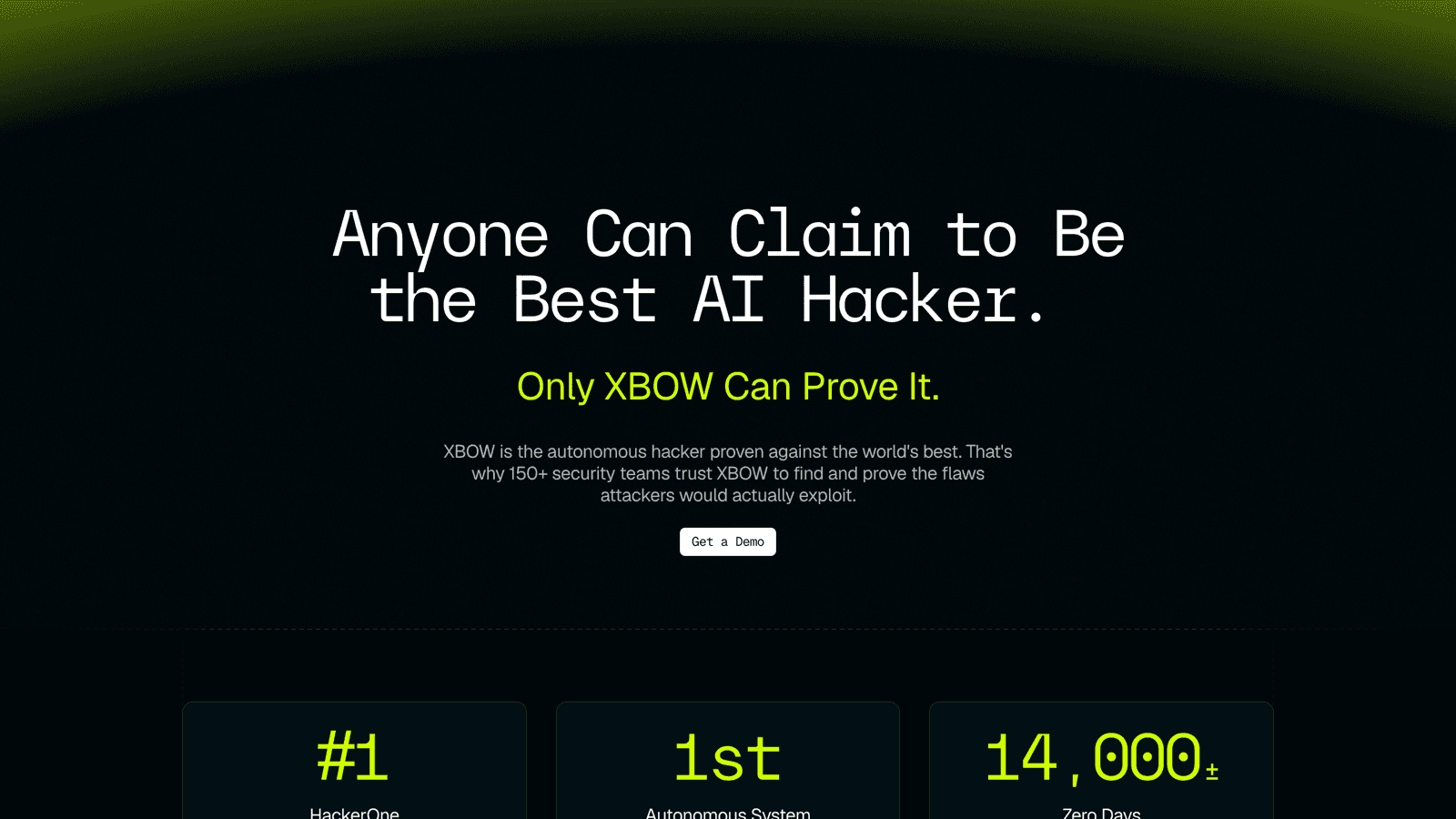
XBOW is the autonomous AI pentester that made headlines by topping the HackerOne US leaderboard above every human researcher. Point it at a URL and it returns working exploits, the exploit proof SonarQube’s static findings can never deliver.
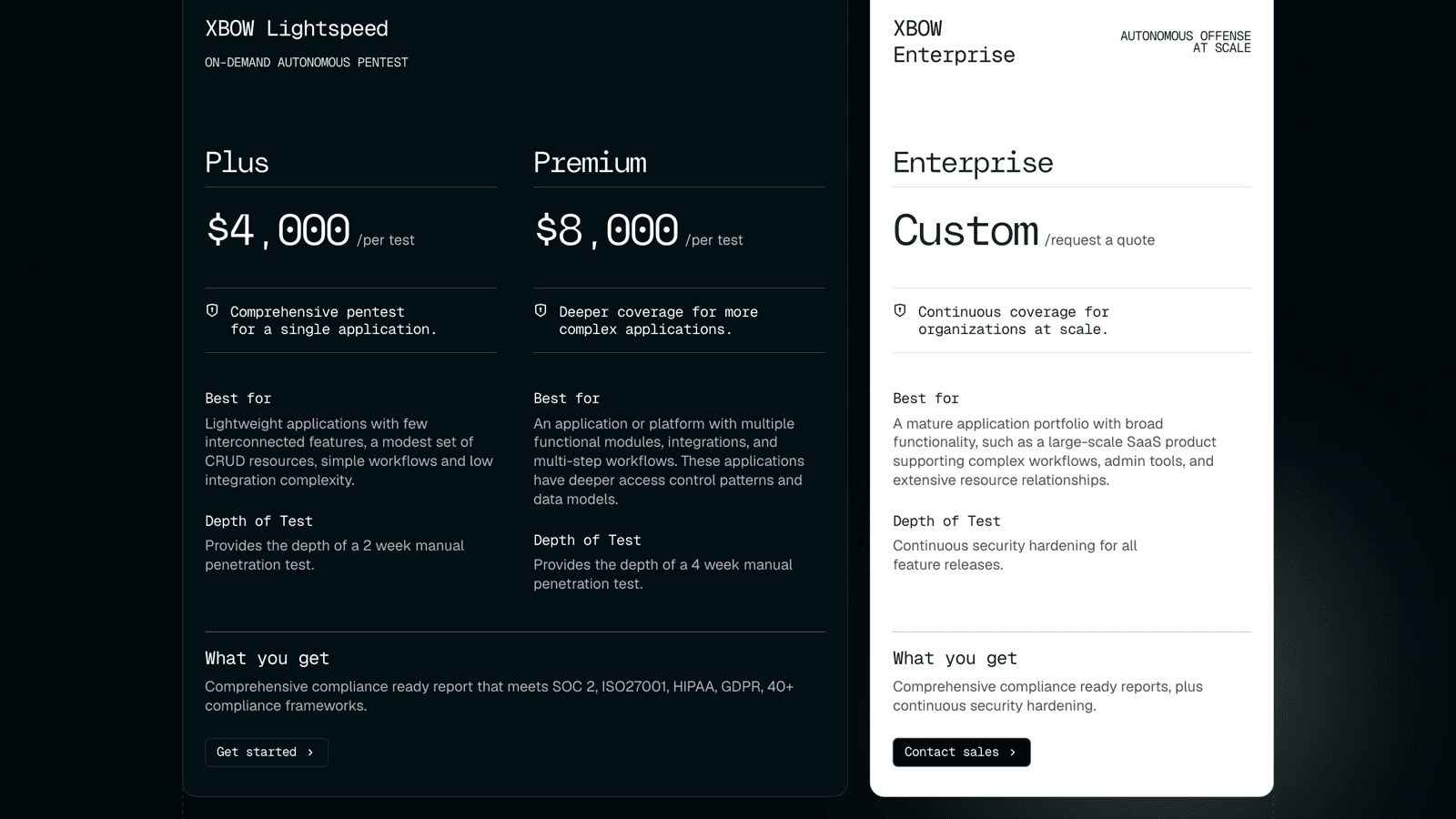
For a SonarQube team, XBOW is a focused offensive tool for web apps and APIs, and it publishes list prices anchored to manual pentest value. Its own pricing calls $4,000 “the depth of a 2 week manual penetration test.”
Features of XBOW
Working exploits where Sonar reports patterns. A five-stage learn-map-coordinate-attack-prove loop runs thousands of short-lived agents in parallel against a target URL.
Validated findings, near-zero false positives. Independent validators confirm each exploit with an end-to-end trace and CWE grouping, closing the gap a static rule leaves open.
Model routing that sharpens as frontier models ship. XBOW picks the best model per task with no lock-in.
Pentests triggered from the pipeline. A REST API and webhooks kick off a test on merge or pre-deploy, plus continuous coverage on Enterprise.
Pros of XBOW
Bug-bounty results that hold up in public. A veteran security researcher wrote that if XBOW “managed to find valid bugs across multiple programs using ‘just their software’, that’s impressive,” adding “topping the VDP leaderboard is still not an easy thing to do.”
Priced against a manual pentest, not a scan. XBOW anchors its $4,000 tier to a two-week pentest and its $8,000 tier to a four-week one.
Chaining a scanner cannot reproduce. Moderna’s Deputy CISO praised its ability to chain bugs into attack chains, “something no other product is doing well in the web space.”
Cons of XBOW
Web and API only, none of Sonar’s static ground. XBOW’s docs scope it to web apps and their APIs, with no SAST, network, or mobile testing.
Skeptics on how deep the bugs go. A veteran practitioner noted its HackerOne badges are “some of the more basic things you can find with automation.”
Not the self-serve it advertises. Every CTA routes to a contact form, and the CEO acknowledges you must “give it a URL to start with, possibly… some additional information like credentials.”
XBOW vs SonarQube pricing
What’s included | SonarQube | XBOW |
|---|---|---|
Entry paid price | $34 / month (Cloud Team) | $4,000 per test (Plus) |
Deeper tier | Custom above 100k LOC | $8,000 per test (Premium), Enterprise custom |
Value anchor | Per line of code | Plus equals a 2-week pentest, Premium a 4-week pentest |
Free option | Community Build, free for public repos | No free trial |
Scope | Source code, 40-plus languages | Web apps and APIs only |
Best for: teams that keep SonarQube for static depth and want fast, autonomous, exploit-proven pentests of web apps and APIs.
13. Hadrian
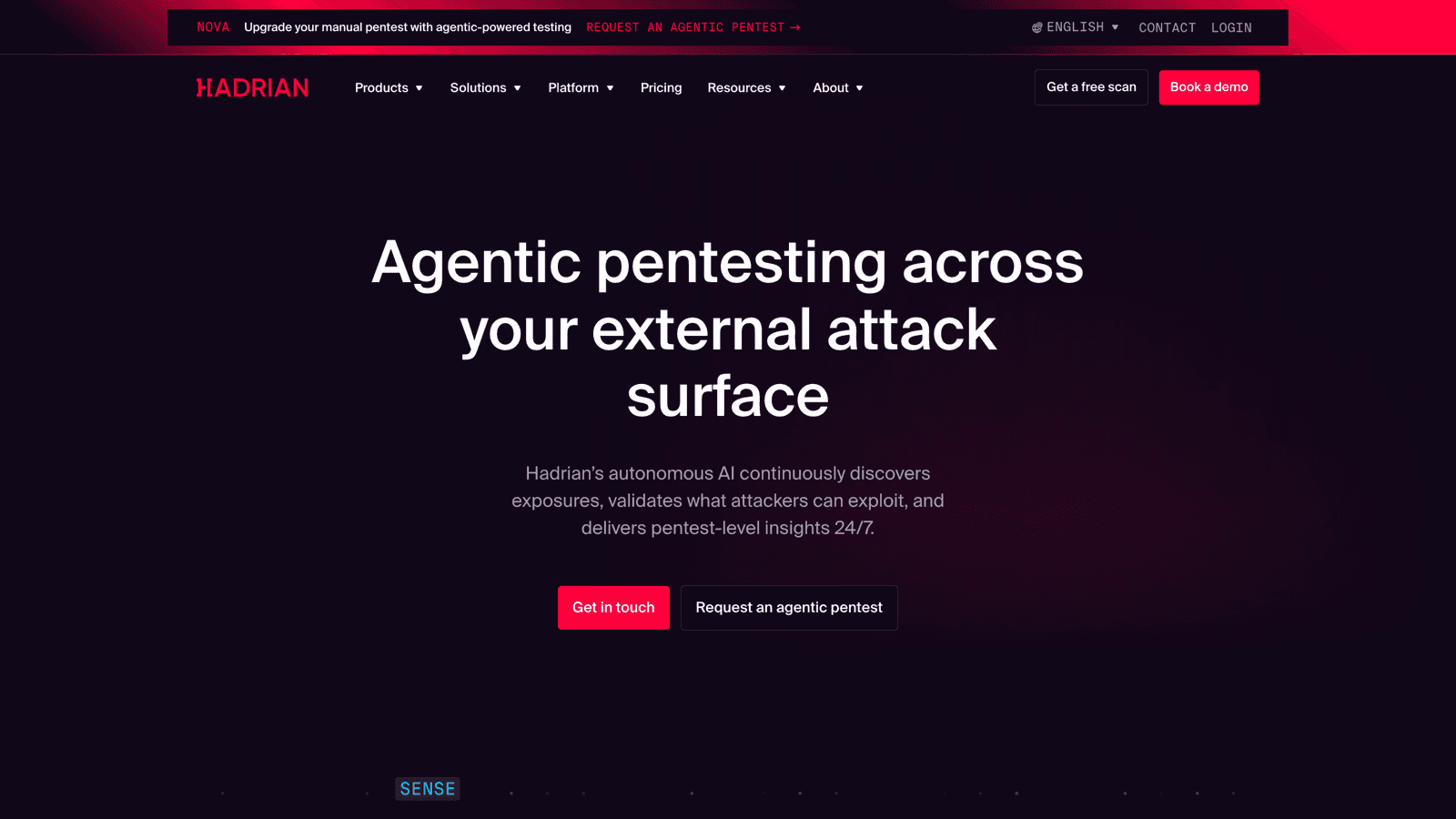
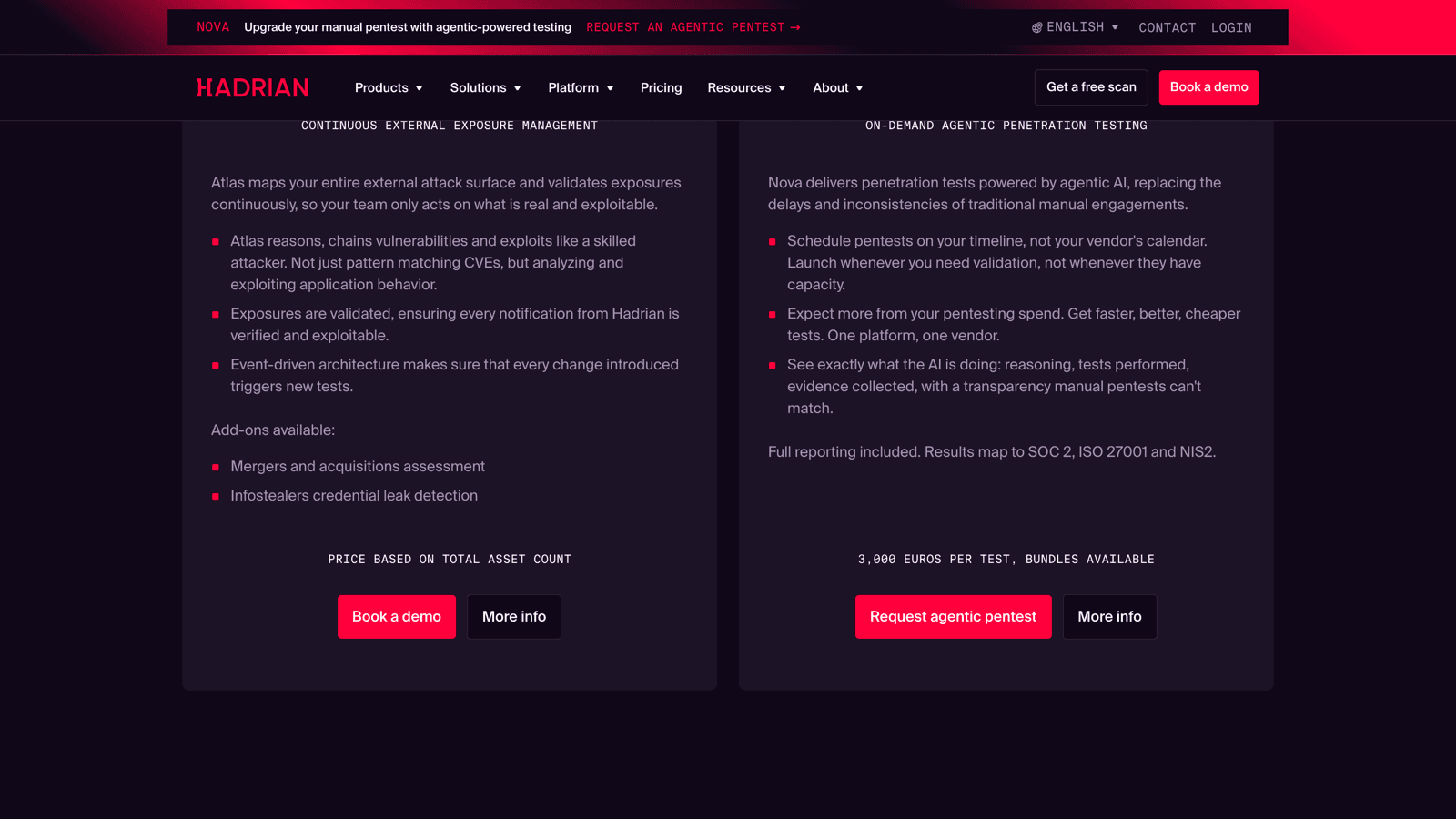
Hadrian is an agentic offensive-security platform for the external attack surface, the outermost layer from SonarQube’s repository focus. It starts with zero scope, discovers assets the way an attacker would, and validates what is genuinely exploitable 24/7.
Its two products, Atlas for continuous exposure management and Nova for on-demand pentests, target SOC teams and CISOs rather than developers directly. For a SonarQube user, Hadrian answers a question static code analysis cannot even ask, what is exposed and exploitable from the outside.
Features of Hadrian
The external attack surface, the far edge from Sonar’s repo. Atlas maps every internet-facing asset automatically, with passive scans hourly and event-driven testing on any change.
Validated risks with a proof of concept attached. An AI Orchestrator proves each finding step by step, claiming 99% noise elimination, evidence a static scan does not produce.
On-demand agentic pentests in a day. Nova tests web apps, APIs, and cloud on demand and returns validated findings in 24 to 48 hours.
Dark-web signal a code scan never touches. Infostealer-leak and compromised-credential detection, plus a mergers-and-acquisitions assessment add-on.
Pros of Hadrian
Continuous visibility instead of a quarterly wait. A mid-market reviewer wrote on G2 that “Hadrian provides real-time visibility of risks that we would have to wait until a penetration test to discover. It was simple to set up and has become a daily part of our workflows.”
Findings you can trust without re-checking. An enterprise reviewer noted “prior solutions generated a lot of false-positives which costed a lot of time to investigate. When Hadrian reports a vulnerability you know it is real.”
Value in minutes, no server to run. An enterprise reviewer said “the system is live and working within minutes and provides insights on external attack surface in a intuitive and simple dashboard.”
Cons of Hadrian
External only, no code or SAST. Hadrian scopes itself to the external surface with no shift-left product, so it never overlaps SonarQube’s job.
Reporting and workflow still maturing. Reviewers on G2 flagged “missing reporting or exporting functionalities” and features that “are not always fully completed.”
A thin review base and a premium price. Hadrian has only four G2 reviews, and one enterprise reviewer noted “the pricing is a bit high.”
Hadrian vs SonarQube pricing
What’s included | SonarQube | Hadrian |
|---|---|---|
Entry paid price | $34 / month (Cloud Team) | €3,000 per test (Nova), Atlas priced on asset count |
Billing unit | Per line of code | Per test (one URL) for Nova, prepaid entitlements |
Free option | Community Build, free for public repos | A conditional free external scan (email only) |
Scope | Source code only | External attack surface only |
SAST | Built-in | Not offered |
Best for: SOC teams and CISOs that keep SonarQube for code and need continuous, validated external attack-surface testing.
Where This Leaves You
SonarQube remains the deepest static-analysis engine in the field, and for teams that need pure code verification across 40-plus languages it earns its place. The reasons to look elsewhere are specific: the per-line-of-code bill that jumps past 100k LOC, the absent DAST, and the missing penetration test that turns a CVSS score into proof.
CodeAnt AI closes those gaps by keeping the static review a SonarQube user expects, pricing it per seat, and adding agentic pen testing you pay for only when it hands you a working exploit. Start with the free open-source plan or the trial, connect a repo, and let the first pull-request review and pentest scan show the difference.
For the wider field, compare the static engines in our best SAST tools comparison, read the guide to the best AI penetration testing tools, and see how pentest as a service works alongside your code scanner.
FAQs
What is the best SonarQube alternative in 2026?
Does SonarQube do penetration testing or DAST?
Is there a free SonarQube alternative?
Why is SonarQube pricing hard to predict?
Which SonarQube alternative is best for AI-generated code?